INDOOR AIR QUALITY
200 likes | 425 Vues
INDOOR AIR QUALITY. FINDING THE PROBLEM. DEFINITIONS. ACCEPTABLE INDOOR AIR QUALITY Air in which there are no known contaminants at harmful concentrations as determined by cognizant authorities.


INDOOR AIR QUALITY
E N D
Presentation Transcript
INDOOR AIR QUALITY FINDING THE PROBLEM
DEFINITIONS • ACCEPTABLE INDOOR AIR QUALITY • Air in which there are no known contaminants at harmful concentrations as determined by cognizant authorities. • A substantial majority (80% or more) of the people exposed are not expressing dissatisfaction with air quality • Source: ASHRAE standard 1990, 62-1989
DEFINITIONS • SICK BUILDING SYNDROME (SBS) • A building that has a large number of complaints derived from occupants. • Complaints may not be clinically diagnosed or medically verified • BUILDING RELATED ILLNESS (BRI) • When the illness is diagnosable.
IAQ FACTORS • Physical • Psychological
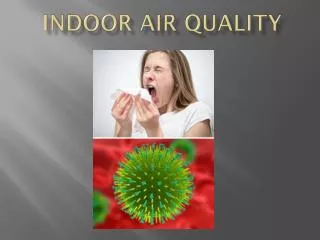
Headache Fatigue Shortness of breath Sinus congestion Cough Sneezing Skin irritation Dizziness Nausea Eye, nose, throat irritation COMMON SYMPTOMS
THE PROBLEM • NIOSH studies have shown that over 50% of the complaints in a building are in some way related to the heating, ventilating and air conditioning system (HVAC)
ENVIRONMENTAL VARIABLES • Air temperature • Mean radiant temperature • Relative air velocity • Ambient water vapor pressure (relative humidity)
PERSONAL VARIABLES • Activity Level • Clothing Level Source: ASHRAE Fundamentals Handbook 1993
ENVIRONMENTAL COMPLAINTS • Too hot • Too cold • Too humid • Too dry • Poor ventilation • Mold • Dust
GO LOOK INVESTIGATE
THE HVAC SYSTEM • Outside air intake • Filter sections • Coils and drain pans • Fans • Supply duct • Return path/duct
MAINTENANCE • Watch for water accumulation • 50% of the IAQ problems are microbiological • Air quality tests seldom, if ever, identify a specific problem
MAINTENANCE • Custodial • Condensate/P-Traps