Westward Expansion
The Westward Expansion, encompassing the territory between the Mississippi River and the Pacific Ocean, was marked by significant cultural exchanges and conflicts. This era saw the establishment of trade routes, like the Santa Fe and Oregon Trails, driven by both push and pull factors such as job shortages and the lure of fertile lands. Tensions escalated between American settlers and Native Americans, particularly following the discovery of gold. The struggle for Texas independence from Mexico and the subsequent Mexican-American War highlight the complex dynamics of this expansion.

Westward Expansion
E N D
Presentation Transcript
Westward Expansion Chapter 13
The West • “The West” was anywhere between the Mississippi River and the Pacific Ocean-That was the Western Frontier • Because it was hard to farm in the Great Plains, the land was used for Transportation • The Northwest had fertile lands
The West • The Southwest was owned by Mexico, and was part of the Spanish Borderlands. • People in these areas were only allowed to trade with Spain • This area has a distinct culture
The West • Spanish missionaries like JuniperoSerro tried to turn Native Americans into Catholics • Natives were forced to live and work at missions, may died from overwork or disease • Buildings were and are still made with a similar look
The West • In 1821, Mexico won their independence from Spain • Mexico made land grants to rancheros and removed missionaries • Because the land given often belonged to the Natives, the Indians raided ranches
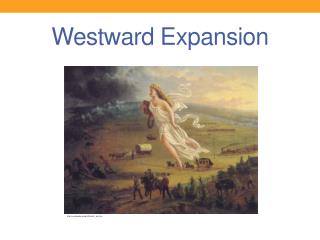
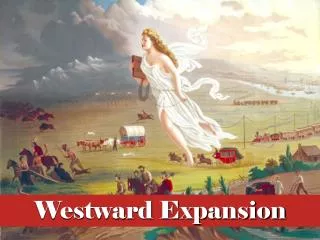
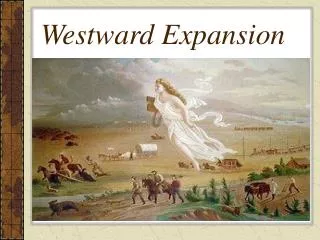
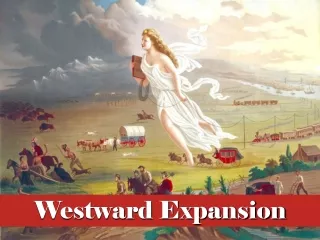
The West • America had been interested in Westward Expansion • They began to believe in Manifest Destiny, which was the idea that the country should go from the Atlantic to the Pacific.
Manifest Destiny cont….. • Definition: the belief that the United States was destined to stretch across the continent from the Atlantic Ocean to the Pacific Ocean.
Why move???? • Push Factors: A force which acts to drive (push) people away from a place. *Pull Factors: Draws (pulls) a person to a new location.
Push/Pull Factors • With someone sitting close to you, make a T-Chart and categorize the events into push factors and pull factors. • Shortage of Jobs • Better Living • Shortage of farm land • Over Crowding • Opportunity to buy cheap land • Gold Rush Push Factors Pull Factors 1.Shortage of jobs 2. Shortage of farmland 3.Overcrowding • Better Living • Cheap Land • Gold Rush
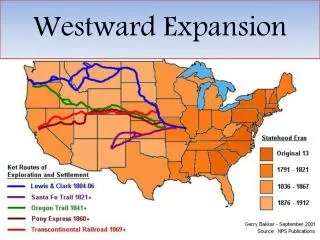
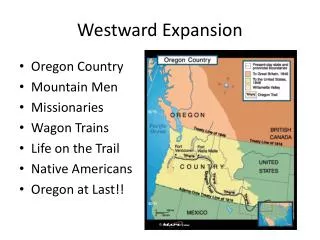
Trails to the West • There were many trails to the west. • Santa Fe Trail: From St. Louis to Santa Fe, New Mexico. • Oregon Trail: From St. Louis to Portland, Oregon
Trails to the West • John Jacob Astor established the American Fur Company in 1808 in Oregon after he traveled there • He used information the Lewis and Clark created
Trails to the West • The first people to built permanent homes in Oregon were missionaries • Marcus and Narcissa Whitman tried to help the natives, but in reality land was simply stolen from the natives. • When people heard there was good land, more settlers came • This started “Oregon Fever”
Trails to the West • Mountain men became famous. • They led isolated lives in the bitter cold, intense heat animal attacks • Trappers would bring their furs to a rendezvous where the mountain men would come together and bargain for the prices of furs
Trails to the West • Working with only hand tools, people had to clear land, plant crops and build shelters • Diseases, accidents and natural disasters were common. • Some settlers even gave up and returned east
Trails to the West • Women worked with men to make their family farms successful • Women also fought for the right to vote • In 1869, the Wyoming territory was the first that let women vote
Trails to the West • Natives had an uneasy peace with the whites • After gold was discovered in Oregon in 1850, white and Chinese miners came into the area • War broke out with the Natives
Conflict with Mexico • Conflict between Mexico and the Americans in Texas • Americans were moving to Texas, and they were Protestant, not Catholic • The Americans were bringing slaves, which was outlawed in Mexico • The Mexican democracy was overturned by Santa Anna, and he turned it to a dictatorship • In 1836, the Texans declared independence from Mexico and created the Republic of Texas
Conflict with Mexico • Santa Anna attacked the Alamo • The Americans defended it for 12 days until the Mexicans took over • A few months later, Sam Houston, led a small army to attack Santa Anna’s army • They captured the leader and signed a treaty that gave Texas independence.
Conflict with Mexico • Sam Houston became the President of the Republic of Texas • He hoped that the United States would Annex Texas • Initially they were not annexed because there was no free state to balance them
Conflict with Mexico • President John Tyler asked congress to annex Texas 3 days before he left his presidency • Although Santa Anna had signed a treaty, Mexico claimed that it was not truly a treaty
Conflict with Mexico • President James K. Polk offered to pay Mexico for the border of Texas and to pay for California • This angered Mexico • This began a war with Mexico • This was called the Mexican American War • Most Americans supported the war • But Northerners said it was about extending slavery
Conflict with Mexico • Polk sent troops to New Mexico and to California • Settlers in California declared themselves an independent republic • They rose a grizzly bear flag • Although Mexico tried to defend California and New Mexico, they did not have the troops
Conflict with Mexico • General Zachary Taylor invaded Mexico, the Americans invaded and took over the capital • The Americans had won the war
Conflict with Mexico • The treaty that ended the war was the Treaty of Guadalupe Hidalgo • They won the Mexican Cession which included California, Nevada and Utah as well as part of Wyoming, Colorado, Arizona and New Mexico • They had also had the Gadsden Purchase which made Manifest Destiny complete
The Mormons Come West Why did they go west?
Where did they go? • They followed what is today known as the Mormon Trail • The trail passes through Iowa, Nebraska, Wyoming and Utah • The trail later extended to California
Where did they come from? • Many Mormons actually started in New York • They moved to Ohio and Missouri • Because of persecution, they went to Illinois and built the city of Nauvoo on the Mississippi River
Why leave Nauvoo then? • Nauvoo was a great city • The Mormons worked together to build homes,businesses, and a temple • Many people didn’t like the Mormons’ success and were afraid • They persecuted the Mormons • They killed the Mormon leader, Joseph Smith and his brother Hyrum Smith in June of 1844 • The Mormons were forced to leave their homes again
What did they do then? • Brigham Young and other leaders decided to go west • They felt that the Rocky Mountains might provide a safe place • They gathered all the provisions they could and began leaving Nauvoo in 1846 • They only got to around Council Bluffs, Iowa before they stopped for the winter • They named their camp Winter Quarters
Hardships • There was a hard winter and many deaths • Also, 500 men said good bye to their families and were enlisted to fight in the War with Mexico • This group became known as the Mormon Battalion
Moving out again • In the Spring of 1847, Brigham Young and a group of mostly men left Winter Quarters heading west • After a long journey, they arrived in the valley of the Great Salt Lake • Brigham Young said, “This is the right place.”
Mormons • Mormons and the government of the United States had conflict for 3 reasons • Mormon church controlled the election process in Utah • The Church only supported businesses for people that were Mormon • Polygamy • It took 40 years to work out these issues, Utah became a state in 1896
A Rush to the West • In 1848, James Marshall found a gold nugget in a ditch in California (Sutter’s Mill) • 80,000 “forty-niners’ ran to California to search for gold • There was both gold above ground and below ground and it the water
A Rush to the West • People were fighting over water rights because the gold would move with the water • Because of the people moving west, towns sprang up • There were vigilantes in these towns • The women who went to California mined, ran and worked in boarding houses, hotels, restaurants, laundries and stores • There was gold found in Idaho, Montana, Colorado, Arizona and Nevada • All different types of people went to California • People from Europe, Asia, Australia and South America
A Rush to the West • Men from China came to America in hopes that they could send home money • They faced prejudice • They could not get jobs in mines, they had to cook or do laundry, work on railroads or farms • Thousands of free African Americans moved to California • They had their own churches, and news papers • They ran their own businesses • But they did not have equal rights • Natives had their lands stolen • Nearly 2/3 of the Natives that lived in California died during the Gold rush