Mechanical Properties Review: Stress, Strain, and Chemical Bonds in Engineering Materials
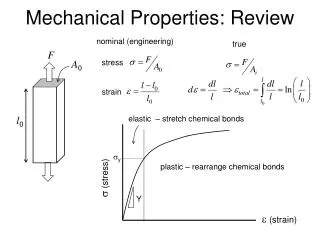
This review explores the mechanical properties of materials, focusing on nominal and true stress-strain relationships. It delves into the effects of elastic and plastic deformation on chemical bonds, highlighting how stress (F and Y) and strain (e) interact during uniaxial tension. The relationship between shear and normal stresses is analyzed, along with the implications of varying orientations. Topics include solvable examples of elastic stretching, the rearrangement of bonds under stress, and mechanisms such as solute and precipitate hardening in materials, both incoherent and coherent.

Mechanical Properties Review: Stress, Strain, and Chemical Bonds in Engineering Materials
E N D
Presentation Transcript
Mechanical Properties: Review nominal (engineering) true F stress A0 strain elastic – stretch chemical bonds l0 sy plastic – rearrange chemical bonds s (stress) Y e (strain)
Shear stress from uniaxial tension force is normal to the plane normal stress F consider what happens on some other plane, A’ A need to know area of A′ A′ = A/cos(f) f q F′ consider shear force parallel to A′ strain A′ need to know magnitude of F′ elastic – stretch chemical bonds F′ = Fcos(q) F′ can be along any direction parallel to A′ (each corresponds to a different q) Final result:tmax = s/2, in the orientation f = q = p/4 plastic – rearrange chemical bonds s (stress) Y e (strain)
Precipitate Hardening incoherent coherent