Comprehensive Guide to Differentiation: Methods, Formulas, and Applications
300 likes | 460 Vues
This guide covers the fundamental methods and formulas of differentiation in calculus. It introduces the concept of the derivative, highlighting key rules such as the product rule, chain rule, and various corollaries. The document includes practical examples involving logarithmic, exponential, and trigonometric functions, along with the use of L'Hospital's rule for indeterminate forms. Exercises related to compounding interest are also provided to showcase real-world applications of differentiation. Elevate your understanding of calculus and its principles of differentiation with this comprehensive resource.


Comprehensive Guide to Differentiation: Methods, Formulas, and Applications
E N D
Presentation Transcript
Definition. Let y = f(x) be a function. The derivative of f is the function whose value at x is the limit • provided this limit exists. Recall
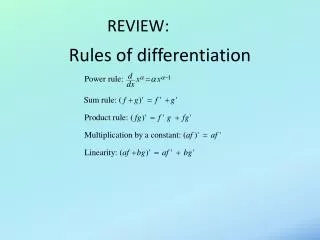
Section 1. Fundamental Formulas for Differentiation • Formula 1.1 The derivative of a constant is 0. • Formula 1.2 The derivative of the identity function f(x)=x is the constant function f'(x)=1. • Formula 1.3 If f and g are differentiable functions, then (f±g)'(x)= f'(x)±g'(x)
Corollary 1.4 (u1+u2+…+un)’= u1’+u2’+…+un’ • Formula 1.5 (The product rule) (fg)'(x) = f(x) g'(x) + g(x) f'(x) • Corollary 1.6 (u1×u2×…×un)’ = u2×…×un×u1’+ u1u3×…×un×u2’+ u1u2u4×…×un×u3’ +…+ u1×u2×u3×…×un-1×un’ • Corollary 1.7 (cu)’ = cu’ • Formula 1.8
2. Rules for Differentiation of Composite Functions and Inverse Functions • Formula 2.1 (The Chain Rule) Let F be the composition of two differentiable functions f and g; F(x) = f(g(x)). Then F is differentiable and F'(x) = f'(g(x)) g'(x) Proof: Exercise
Formula 2.2 • (Power Rule) For any rational number n, • where u is a differentiable function of x and u(x)≠0.
Corollary 2.3 For any rational number n, if f(x)=xn where n is a positive integer, then f'(x)= nxn-1
Formula 2.4 • If y is differentiable function of x given by y=f(x), and if x=f –1(y) with f’(x) ≠0, then • Practice
Section 3 The Number e • A man has borrow a amount of $P from a loan shark for a year. The annual interest rate is 100%. Find the total amount after one year if the loan is compounded : • (a) yearly; (b) half-yearly • (c) quarterly (d) monthly; • (e) daily; (f) hourly; • (g) minutely; (h) secondly. • (h) Rank them in ascending order. • (i) Will the amount increase indefinitely? AnswersGraphs
e= = 2.718281828459045… • Furthermore, it can be shown (in Chapter 7 and 8) that: • (1) • (2)
Section 4 Differentiation of Logarithmic and Exponential Functions • Define y = ex and lnx = logex.
Differentiation of Logarithmic function f(x) = lnx Proof: Proof: By Chain Rule and Formula 4.1
Differentiation of Logarithmic and Exponential Functions • Exercises on • Product Rule • Quotient Rule • Chain Rule
Logarithmic Differentiation Examples Read Examples 4.2- 4.4
Formula 4.5 Quiz
Section 5Differentiation of Trigonometric Function Proof of Formula
y=cotx and y=arccotx y=secx and y=arcsecx y=cscx and y=arccscx Graphs
Section 7Differentiation of Inverse of Trigonometric Function Proof of Formula
Section 10 Indeterminate Forms and L’Hospital Rule Indeterminate Forms
(i) Evaluate limx→a f(x)/g(x) where f(a)=g(a)=0. 1. Evaluate limx→o sin3x/sin2x. L’Hospital: limx→o sin3x/sin2x = limx→o 3cos3x/2cos2x = 3/2 2. limx→o (x-sinx)/x3=limx→o (1-cosx)/3x2 = limx→o(sinx)/6x = limx→o(cosx)/6 = 1/6 How? Why?
Proof of 0/0 limx→af(x)/g(x) = limx→a(f(x) – f(a))/(g(x) – g(a)) = limx→a(f(x) – f(a))/(x-a)/(g(x) – g(a))/(x-a) = (limx→a(f(x) – f(a))/(x-a))/( limx→a (g(x) – g(a))/(x-a)) = f’(a)/g’(a)
Differentiation of exponential function f(x) = ex • Theorem. Let f(x)=bx be the exponential function. Then the derivative of f is f'(x) = bx f'(0) • Proof • Hope: e is the real number such that the slope of the tangent line to the graph of the exponential function y=ex at x=0 is 1. • Formula 4.3 Let f(x)=ex be the exponential function. Then the derivative of f is f'(x) = ex