Exploring Sustainable Development in China's Aquatic Environments: A Joint Field Course
10 likes | 125 Vues
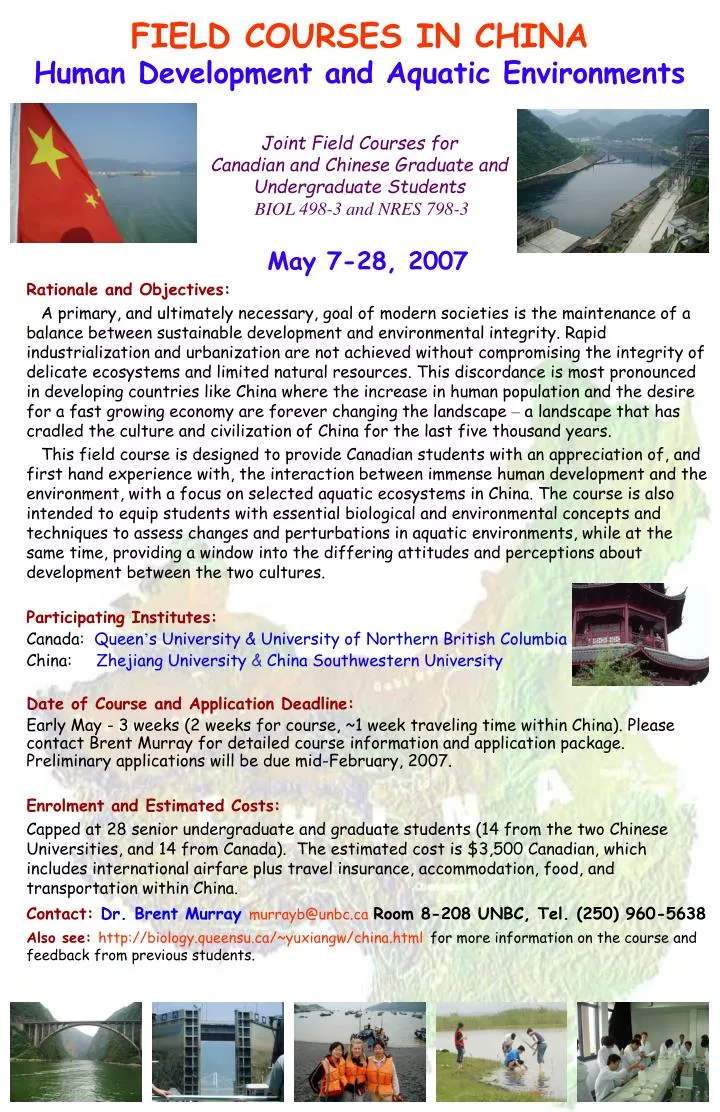
This joint field course for Canadian and Chinese graduate and undergraduate students offers a unique opportunity to study the balance between human development and environmental integrity in China. Held from May 7-28, 2007, it emphasizes the impact of rapid industrialization on aquatic ecosystems. Students will gain firsthand experience assessing ecological changes while understanding cultural differences in perceptions of development. The course, hosted by Queen’s University and the University of Northern British Columbia alongside Zhejiang University and China Southwestern University, costs approximately CAD $3,500.


Exploring Sustainable Development in China's Aquatic Environments: A Joint Field Course
E N D
Presentation Transcript
FIELD COURSES IN CHINA Human Development and Aquatic Environments Joint Field Courses forCanadian and Chinese Graduate and Undergraduate Students BIOL 498-3 and NRES 798-3 May 7-28, 2007 Rationale and Objectives: A primary, and ultimately necessary, goal of modern societies is the maintenance of a balance between sustainable development and environmental integrity. Rapid industrialization and urbanization are not achieved without compromising the integrity of delicate ecosystems and limited natural resources. This discordance is most pronounced in developing countries like China where the increase in human population and the desire for a fast growing economy are forever changing the landscape – a landscape that has cradled the culture and civilization of China for the last five thousand years. This field course is designed to provide Canadian students with an appreciation of, and first hand experience with, the interaction between immense human development and the environment, with a focus on selected aquatic ecosystems in China. The course is also intended to equip students with essential biological and environmental concepts and techniques to assess changes and perturbations in aquatic environments, while at the same time, providing a window into the differing attitudes and perceptions about development between the two cultures. Participating Institutes: Canada: Queen’s University & University of Northern British Columbia China: Zhejiang University& China Southwestern University Date of Course and Application Deadline: Early May - 3 weeks (2 weeks for course, ~1 week traveling time within China). Please contact Brent Murray for detailed course information and application package. Preliminary applications will be due mid-February, 2007. Enrolment and Estimated Costs: Capped at 28 senior undergraduate and graduate students (14 from the two Chinese Universities, and 14 from Canada). The estimated cost is $3,500 Canadian, which includes international airfare plus travel insurance, accommodation, food, and transportation within China. Contact:Dr. Brent Murray murrayb@unbc.ca Room 8-208 UNBC, Tel. (250) 960-5638 Also see: http://biology.queensu.ca/~yuxiangw/china.htmlfor more information on the course and feedback from previous students.