Imaging with Entangled Photons: Revolutionizing Holography
110 likes | 212 Vues
This article explores the groundbreaking use of entangled photons in imaging, tracing the concept of entanglement from Schrödinger's response to the EPR paradox to contemporary experiments in quantum optics. Key techniques such as Spontaneous Parametric Down Conversion (SPDC) illustrate how entangled photon pairs are generated from a single UV photon within a crystal. Experimental demonstrations by researchers from the University of Maryland and Boston University showcase the potential of entangled photons in creating high-resolution holograms, offering fresh insights into non-classical imaging methods.


Imaging with Entangled Photons: Revolutionizing Holography
E N D
Presentation Transcript
Imaging With Entangled Photons Timothy Shokair Physics 138 May 10, 2005
What is Entanglement? • Term Coined by Schrödinger in response to famous 1935 EPR Paradox paper. • EPR claimed Quantum mechanics was incomplete, Schrödinger responded with a statement based on the Copenhagen Interpretation of QM. • Paradox was left alone for 30 years until Bell came up with his theory on hidden variables. • Experiment was done by Freedman and Clauser in 1972 that showed strong evidence against local hidden variable theories. • Further proof by Kwait, Eberhard, Steinberg and Chiao that was unambiguous.
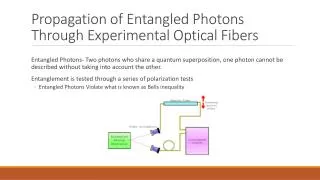
How do we get entangled photons? • Spontaneous Parametric Down Conversion (SPDC). • Three Photon process: One UV photon into a crystal where it is absorbed and two lower energy photons emitted. • The two photons emerge in an entangled state. • See Keller and Rubin Phys. Rev. A v.52 pg. 1534 for full theory.
The Crystal • Beta Barium Borate (BBO) highly nonlinear. • Two types of cuts Type-I, producing photons polarized parallel to each other and Type-II where they are orthogonal. • The photons are termed Signal and Idler.
An Experiment • Pittman, Shih, Strekalov, and Sergienko performed and experiment where they exploited entangled photons to create an image. • University of Maryland Baltimore County December 1994 • Mathematical Details of the Geometry described in a later paper by the same group.
Holography Experiment • Proposed by Abouraddy, Saleh, Sergienko and Teich at Boston University in 2001. • Using similar methods to the UMBC group the propose to use entangled photons for 3D holography. • Signal Photon scatters on remote object while the Idler is locally manipulated using conventional optics.
Conclusion • Entangled Photons have been used to create images and give the possibility of high resolution. • Holography could be used in a completely non-classical way by imaging a remote object in an isolated chamber where light can enter but not escape.