Download
1 / 15
160 likes | 887 Vues
The Entrepreneurship Development Programme (EDP) in India is crucial for fostering self-employment and empowering current and aspiring entrepreneurs. It focuses on enhancing skills, increasing efficiency in business operations, and maintaining product quality. The program encompasses phases such as selecting suitable entrepreneurs, conducting feasibility studies, and providing essential management training. Various organizations like NIESBUD, SISI, SIDO, and NSIC play a vital role in conducting these training programs. This initiative targets education, motivation, and practical training to create a robust entrepreneurial ecosystem.

E N D
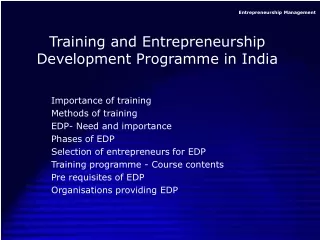
Entrepreneurship Management Training and Entrepreneurship Development Programme in India Importance of training Methods of training EDP- Need and importance Phases of EDP Selection of entrepreneurs for EDP Training programme - Course contents Pre requisites of EDP Organisations providing EDP
Entrepreneurship Management Importance of Training • Ensures availability of skilled manpower at all management levels • Enhancing abilities, potential among entrepreneurs • Increase efficiency • Maintain and enhance product quality • Minimise wastages in production process • Minimise accidents on the job • Reduce fatigue and increase speed of work • Standardisation in industry and internal processes
Entrepreneurship Management Methods of Training • Individual instruction • Group instruction • Lecture method • Demonstration method • Written instruction method • Conference • Meetings
Entrepreneurship Management EDP • Designed with an aim of encouraging self employment • Imparts training and motivates potential and existing entrepreneurs to start new business or diversify and expand the existing one • Helps employment and wealth creation among educated unemployed youth • Well equipped to face risks and challenges as an entrepreneur • Government needs considerable human and material resource, importance to detailed planning & implementation
Entrepreneurship Management Phases of EDP • Select area from existing government policy guidelines/socio-economic reports • Techno-economic survey of the selected area; feasibility study • Identify potential and existing entrepreneurs interested in starting new business/expansion/diversification • Training • Follow up and consultancy services
Entrepreneurship Management Selection of entrepreneurs for EDP • The programme is well publicised and promoted to attract maximum applications for screening • Selection of top 25 to 30 applicants only • Applications screened for: • Demographics and socio cultural data – age, education, work exp, financial resources, type of business etc • Motivation factors – pull factors, source of encouragement, credibility, endurance, concreteness of plans • Psychological test results- traits like risk taking, need for achievement
Entrepreneurship Management Training – Course contents • Introduction to entrepreneurship • Motivation training • Essentials of management • Fundamentals of project feasibility study • Organising the business • Plant visit
Entrepreneurship Management Pre requisites of EDP • Selection of entrepreneurs • Inputs for EDP • Support system • Follow up
Entrepreneurship Management Organisations providing EDP
Entrepreneurship Management National Institute for entrepreneurship and Small Business Development (NIESBUD) • Established by Government of India in 1983 • An apex body for coordination and supervision on activities of various institutes engaged in entrepreneurial development • Helps evolution of EDP, model syllabi, effective training strategies, methodology, manuals and tools • Activities undertaken: • Organise and conduct training programmes • Coordinate training activities of various agencies/institutes • Provide affiliation to such institutes • Hold examinations and confer certificates to trainers and trainees
Entrepreneurship Management Small Industries Service Institutes (SISI) • Three months part time evening courses in management • 4-6 weeks part time courses in intensive training in functional areas (marketing, finance) • Special courses in quality control, HR, production planning, product development etc • Mobile workshops imparting training on correct usage of tools and equipment • Helps with preparation of plant layouts • Helps individual firms on specific problems faced
Entrepreneurship Management Small Industries Development Organisation (SIDO) • Runs EDP in collaboration with financial institutes, directorate of industries • Gives on the job training on shop floor (carpentry, electrical devices) • Sends its officials/trainers to organisations to update their knowledge
Entrepreneurship Management National Small Industries Corporation (NSIC) • Provides apprenticeship for 2 years • Training supervisory staff of SSI up to 2 years • Training to engineers up to 2 years • Training workmen for 12 months • Training to set up own venture • Advice on machinery and components • Production of technologically advanced machines
Entrepreneurship Management Entrepreneurship Development Institute of India (EDII) • Develops programmes for entrepreneurial training and development • Develops innovative training techniques for trainers • Focused attention on women entrepreneurs with first such EDP in 1988 • EDP for rural entrepreneurship development in U.P and Orissa • Famous for organising camps on entrepreneurship • Condusted EDP in Sri Lanka, Nepal, Ghana, Kenya etc
Entrepreneurship Management National Alliance of Young Entrepreneurs (NAYE) • Contribution in encouraging women entrepreneurship • Set up women’s wing in 1975 • This wing assists women in: • Getting better access to resources, infrastructure, markets • Identify investment opportunities • Attending to problems of individual industries • Sponsor participation in trade fairs, exhibitions, conferences • Organise seminars, training programmes, workshops