Digestive System
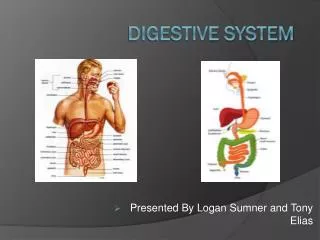
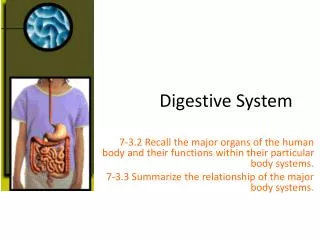
Chapter 15 focuses on the structure and function of the tongue and its integral role in digestion. Composed mostly of muscle tissue, the tongue helps with taste through papillae housing taste buds for sweet, sour, salt, and bitter flavors. The chapter also covers the anatomy of the palate, tonsils, and teeth, detailing their types and functions. It discusses the various salivary glands responsible for producing saliva, which contains enzymes like amylase that aid in digestion. Key concepts on esophageal structure and stomach functions provide a comprehensive understanding of the digestive process.

Digestive System
E N D
Presentation Transcript
Digestive System Chapter 15
Tongue • Mostly muscle tissue • What type of muscle would it be? • Frenulum – connects the tongue to the bottom of the mouth • What is the purpose of the tongue? • Papillae – rough projections that contain taste buds • Why would these be rough? • Four types of taste buds – sweet, sour, salt, bitter
Palate • 2 sections • Hard Palate • Also known as the maxilla • Anterior Portion • Soft Palate • Posterior Portion • This and the uvula are drawn up during swallowing • Why is this important? • Blocks off the nasal passage during swallowing
Tonsils • Lingual – at the base of the tongue • Used as anchor, covered by lymphatic tissue • Palatine – Located on the side of the tongue • Which do you think is removed when you have tonsillitis? • Palatine – exposed to many pathogens so they can easily become infected.
Teeth • 2 sets • Primary (baby) – 10 on each jaw • What happens to these? • They are lost • The roots are resorbed and teeth are pushed out by secondary teeth • Secondary (permanent) – 16 on each jaw • Begin to appear around age six
Secondary Teeth • Incisors – total of eight, front teeth • Function? • Tearing off bites • Cuspids (Canine) – total of four, sharper teeth (fangs) • Function? • Rip and Tear tough food.
Secondary Teeth • Bicuspids (premolar) – total of eight, behind cuspids, a bit flatter • Function? • Mash and grind, little bit of tearing • Molars – total of 12, back teeth much flatter (4 first, 4 Second, 4 Third) • Third also known as wisdom teeth • Function? • Mash and Grind • Why do we need so many types of teeth?
Tooth Structure • Based on the name where do you think each part is? • Crown – • Root – • Enamel – • Hardest substance in the body and cannot be replaced • What problem does this pose? • Dentin – deep to the enamel and surrounds the pulp cavity (nutrient supply)
Salivary Glands • Main Secretions • Amylase – breaks down large starch and glycogen molecules • Mucus – • What is its purpose? • Bind food particles and lubricate alimentary canal • What triggers secretions? • Parasympathetic nervous system
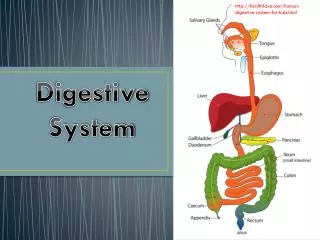
Salivary Glands – 3 different glands • Paratid – Located anterior and inferior to the ear • Secretes saliva rich in amylase • Submandibular – Located where? • Secretes thicker saliva than paratid. • Why thicker? • Sublingual – Located where? • Secretes primarily mucus
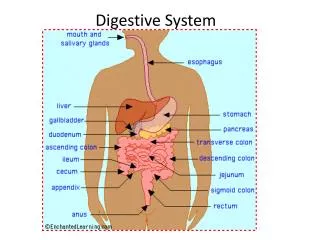
Pharynx • Connects nasal and oral cavities with the esophagus • Contains the epiglottis • What is this? • Flaplike structure used to seal off trachea during swallowing. • Has three sections • - nasopharynx attaches nasal cavity • - oropharynx attaches mouth • - laryngopharynx attaches esophagus
Wall Structure • 4 layers • Mucosa – • Submucosa – • Muscular layer - • Serosa –
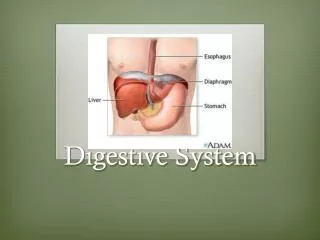
Esophagus • Connects pharynx to stomach • Function - • Ends at lower esophageal sphincter • What is a sphincter? • This one connects the stomach and the esophagus, what will its function be?
Stomach • Location – • Size is small when empty, yet it can hold one liter. How? • What happens in the stomach?
Stomach • Regions of the stomach • Cardiac - posterior to lower esophageal sphincter • Function- • Fundic – Most anterior portion • Function – • Body – Main region • Function – • Pyloric – most posterior region • Function – • Stomach ends at Pyloric Sphincter
Gastric Juice • 4 Components • Pepsin – • Pepsinogen – • Hydrochloric Acid – • Mucus
Gastric Regulation • Produced regularly, but rate can vary • What might cause it to vary? • Gastrin – • What stimulates the release?
Gastric Mixing • How will the stomach perform its functions? • Chyme – • Where does food go to exit stomach? • How does the stomach move it there?
Pancreas • Located near posterior abdominal wall inferior to stomach • Secretes____ into the ___. • Amylase • Lipase • Nuclease • What other important function?
Liver • Located… • Lobed • Multiple Functions • Blood – • Storage - • Digestive functions • Metabolism of Carbohydrates, Lipids and Proteins • Secretes ____ through the ___into the ____.
Bile • Consists of: • 1. • Two types biliverdin and bilirubin • 2. • Only part of the bile that has digestive function • Emulsification • 3.
Gallbladder • Storage area • What does it store? • Reabsorbs water to concentrate __________. • Hormones stimulate sphincter to relax, open duct • Causing what to happen?
Questions • If a person had a condition which limited their ability to produce hydrochloric acid in the stomach, how might this affect digestion and why? • If someone lost control of their pyloric sphincter and was unable to contract it, how would this affect digestion? • Thinking about the contents of the stomach, what might happen to a person with a lower esophageal sphincter that does not contract completely?