Understanding Measurements: Precision, Accuracy, and the Art of Estimation
This educational resource focuses on how to accurately record and measure various values A, B, and C. It emphasizes the importance of stating certain digits and estimating one additional digit to showcase the precision of measuring instruments. You'll learn about uncertainties in measurements, the impact of environmental factors, and the distinction between precision and accuracy. The accompanying worksheet provides practical experience in measuring with a ruler and analyzing dart throws to understand the concepts better.

Understanding Measurements: Precision, Accuracy, and the Art of Estimation
E N D
Presentation Transcript
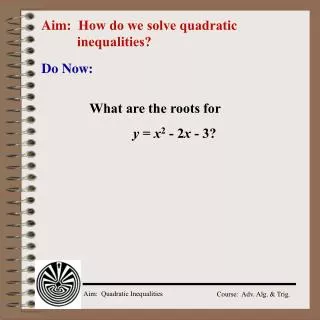
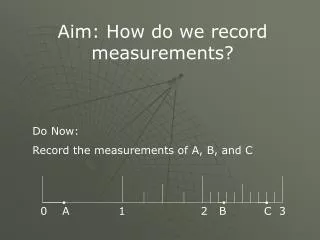
Aim: How do we record measurements? Do Now: Record the measurements of A, B, and C 0 A 1 2 B C 3
Rule: State the digits that you know for certain and estimate one extra digit. This shows the precision of your measuring instrument. Acceptable answers to the do now: A – 0.2 0.3 0.4 B – 2.26 2.27 2.28 2.29 C – 2.80 Estimated digit Certain digits B and C are more precise measurements Certain digit Certain digits Estimated digit Estimated digit
Worksheet on measurements Take out a ruler
12.01 12.51 9.71 11.30 13.26 12.97 14.34 13.94 11.72 10.31
-2.4 37.9 -10.5 34.6 8.1 86.5
4.50 45.0 7.40 74.0 3.50 35.0 4.15 41.5 9.25 92.5 8.70 87.0 1.35 13.5
Uncertainties in Measurements • In devices: • A metal ruler’s length can change with changes in temperature • Electric devices can be affected by magnetic fields near them • With People: • Reading an instrument from an angle (not at eye level) could result in incorrect readings
Parallax – the apparent shift in the position of an object when it is viewed from various angles Precision – the degree of exactness to which a measurement can be reproduced - limited to the smallest division on the scale of the instrument Accuracy – how well the result agrees with an accepted value
Describe the dart player’s throws: x x x x x x x x x Precise Not accurate Not precise Not accurate Precise Accurate
Pages for Additional Reading Page 25