Contingency Tables
This analysis utilizes contingency tables to investigate how students' smoking habits relate to their parents' smoking behaviors. We explore whether an independent variable (parental smoking) affects a dependent variable (student smoking) through survey data collected from eight high schools in Arizona. The findings reveal that 22.5% of students smoke when both parents smoke, significantly higher than the overall sample rate of 18.7%. In contrast, only 13.9% of students smoke when neither parent smokes, indicating a clear influence of parental habits on student behavior.

Contingency Tables
E N D
Presentation Transcript
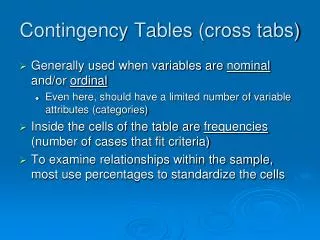
Contingency tables – or crosstabs • display data so we can see if one variable seems to be having an effect on a second variable (does the independent variable effect the dependent variable?) • independent variable: displayed across the top (column) • dependent variable: down the sides (rows)
How are the smoking habits of students related to their parents’ smoking? Here are data from a survey of students in eight Arizona high schools:
How are the smoking habits of students related to their parents’ smoking? Here are data from a survey of students in eight Arizona high schools:
How are the smoking habits of students related to their parents’ smoking? Here are data from a survey of students in eight Arizona high schools:
How are the smoking habits of students related to their parents’ smoking? Here are data from a survey of students in eight Arizona high schools:
How are the smoking habits of students related to their parents’ smoking? Here are data from a survey of students in eight Arizona high schools: • Compared to the entire sample in which 18.7% of the students smoke: • -The value was higher with 22.5% of the students smoked when both parents smoke • - On the other hand, 13.9 % of students smoked when neither parent smoked, this value is lower compared to the entire population.