Analyzing Coarse and Fine Detail Splitting in Digital and Analogue Signal Processing
This document explores the separation of coarse and fine details in digital and analogue signal processing. It addresses the role of FIR filters and the energy-preserving conditions set by Vetterli’s principles. By analyzing sequences and employing orthonormal families, the document elucidates the synthesis and analysis techniques for decomposing signals into their respective coarse and fine components. The focus is on down-sampling, scaling functions, and wavelet associations while ensuring the orthogonality of the filter coefficients for effective data fidelity and representation.

Analyzing Coarse and Fine Detail Splitting in Digital and Analogue Signal Processing
E N D
Presentation Transcript
Coarse + Fine: Splitting: coarse at resn 3 = coarse at resn 2 + fine detail at resn 2 coarse at resn 3 = coarse at resn 2 + fine detail at resn 2
Splitting: Data: sequence Fix FIR filter Vetterli Condition Interpret? Now Down-sample: HALVE NUMBER of TERMS
Orthonormal families: Define Synthesizing operator by: Another Synthesizing operator: Theorem: energy-preserving when Vetterli satisfied. So: , ORTHOGONAL ORTHONORMAL FAMILIES
Interpret Splitting: Analyzed sequences: Analyze and Synthesize: coarse detail fine detail
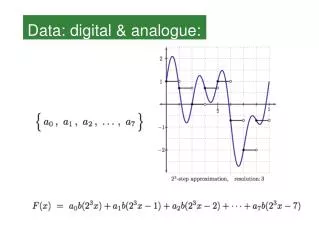
Fix FIR filter Analogue case: Choose scaling function , associated wavelet , orthonormal families for each k. Important property: othogonal, i.e. perpendicular Level 1 resolution function:
Coarse + Fine detail: Coarse detail : use scaling function family at level 0 , Fine detail : use wavelet family at level 0 , Relate , to filter coefficients?
2-scale equation again: Exploit as before Coarse detail coefficients:
2-scale equation again: Fine detail coefficients: Analyze and Synthesize: coarse detail fine detail