Download
1 / 4
40 likes | 151 Vues
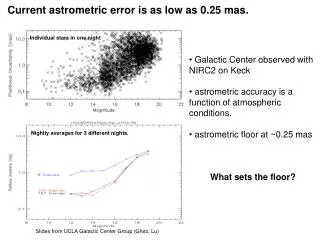
Recent observations at the Galactic Center with NIRC2 on the Keck Observatory reveal an astrometric accuracy as low as 0.25 mas. This remarkable precision is highly dependent on atmospheric conditions and demonstrates the astrometric floor achieved under nightly averages. Analyzing data from 107 exposures reveals the dependence of positional errors on both isoplanatic and isokinetic effects, with an emphasis on the importance of reference stars in improving measurements. Understanding and mitigating these variables promises enhanced accuracy in future astrophysical research.

E N D
Current astrometric error is as low as 0.25 mas. Individual stars in one night • Galactic Center observed with NIRC2 on Keck • astrometric accuracy is a function of atmospheric conditions. • astrometric floor at ~0.25 mas • What sets the floor? Nightly averages for 3 different nights. Slides from UCLA Galactic Center Group (Ghez, Lu)
Astrometric accuracy is a function of location in the field. • Use 1 night of GC data: • LGSAO, NIRC2 • 107 exposures • tint = 60 sec each • Strehls: 0.3 - 0.4 • FWHM: 53 - 63 mas • WFE ~ 345 nm (Marechal) • Simultaneous MASS/DIMM (estimated at zenith): • r0 = 10 - 15 cm • theta0 = 1.5’’ - 3.0’’ • Courtesy of Matthew Britton: http://eraserhead.caltech.edu/keck/galactic_center/turbulence_plots/turbulence_plots.html Slides from UCLA Galactic Center Group (Ghez, Lu)
Galactic Center data shows strong isoplanatic effects dependence on astrometric error. • In each frame, measure the position relative to the reference star, which is close to the laser spot. • Take the RMS from all frames. • The RMS positional error can be decomposed into radial and tangential components relative to the laser position (or reference source). Slides from UCLA Galactic Center Group (Ghez, Lu)
PSF elongation seems strongest in elevation direction. • PSF degrades due to both isoplanatic and isokinetic effects. • Isoplanatic effects dominate… isokinetic still under investigation. • Differential tip-tilt jitter masked by larger effects? • anisoplanatism • chromatic differential atmospheric refraction along elevation? • Need an astrometry experiment with the tip-tilt star and a separate guide star in the FOV. Slides from UCLA Galactic Center Group (Ghez, Lu)