Understanding Atomic Structure: Arrangements of Protons and Electrons
This comprehensive exploration delves into the arrangement of protons and electrons within atoms. It covers various atomic models developed over time, including Democritus’ particles, Dalton’s solid spheres, Thomson’s plum pudding, Rutherford’s nuclear model, and Bohr’s planetary model. Students will engage in activities to visualize and comprehend atomic structures through experiments, group discussions, and black box activities. The content is designed to foster an understanding of how atomic structures vary by element and the significance of these models in modern science.

Understanding Atomic Structure: Arrangements of Protons and Electrons
E N D
Presentation Transcript
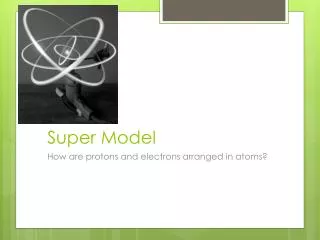
Super Model How are protons and electrons arranged in atoms?
Notebook • Super Model, Part 1 • How are electrons and protons arranged in an atom? • Put it in your TOC
Page 162 • Different spectra caused by differences between atoms • Questions we’re asking: • HOW are they different? • How does the structure of an atom vary from element to element?
Models • What does a model do? • What does it allow us to do that we normally wouldn’t do? • http://www.youtube.com/watch?v=xqNSQ3OQMGI
Page 167 – What is a Model? • Physical Model • An object on a different scale • Example? • Conceptual model • Describes a system, not a thing • Example?
Blind Drawing Activity • One person come up to the board • Feel an object in their hands, EYES CLOSED • Have 20 seconds to draw it on the board • You are modeling using evidence…
Process and Procedure • #1: Read 164-165 • INSTEAD of #2: • Explain Rutherford’s experiment by using a sentence for each of these words. Show how it is related to the reading/experiment. • Use these words: • Gold foil, alpha particles, nucleus, empty space, rebound, target, model, protons, electrons, positive, negative
Web stuff • http://www.mhhe.com/physsci/chemistry/essentialchemistry/flash/ruther14.swf
Stop and Think, p. 169 • Let’s just discuss #2 • Good discussion looks like what? • Respectful • Quiet when it’s not your turn • Creative
History of the Atom • The modern model of the atom has evolved over a long period of time through the work of many scientists • Democritus • matter is made up of particles called atoms • Dalton • atoms of the same element are alike • solid indivisible spheres • Thomson • cathode ray tube • discovers electrons • plum pudding model
History of the Atom • Rutherford • Gold foil experiment • discovers a massive (heavy) positively (+) charged nucleus • most of the atoms volume is empty space • nuclear model
History of the Atom • Continued • Bohr • Hydrogen emission spectra • electron energy is quantized – electrons can only have certain orbits with certain radii • planetary model • Schrödinger • Aided by many famous scientists (De Broglie, Heisenberg, etc…) • Wave-mechanical or electron cloud or quantum-mechanical model (very complex)
Question: Subatomic particles can usually pass undeflected through an atom because the volume of an atom is composed of (1) an uncharged nucleus (2) largely empty space (3) neutrons (4) protons þ
Question: One model of the atom states that atoms are tiny particles composed of a uniform mixture of positive and negative charges. Scientists conducted an experiment where alpha particles were aimed at a thin layer of gold atoms. Most of the alpha particles passed directly through the gold atoms. A few alpha particles were deflected from their straight-line paths. An illustration of the experiment is shown below.
Black Box Activity • Eight groups • Each group chooses a SECRET object • Place the object in the box at your station • Make sure others don’t see it • Go around and record what you observe/test for the other boxes • Make a guess • You can walk around alone or in a group