Download
1 / 6
60 likes | 194 Vues
This analysis compares the innovative bridge designs of Robert Maillart and Santiago Calatrava, highlighting their unique contributions to structural engineering. While Maillart focused on efficiency and structural art with reinforced concrete, Calatrava emphasized aesthetics and urban renewal through his parabolic tied-arch footbridge designs. Both engineers share a similar visual aesthetic yet differ in their environmental contexts, materials, and construction costs. Their pioneering efforts in bridge design illustrate the evolution of engineering practices and the blending of functionality with elegance in urban landscapes.

E N D
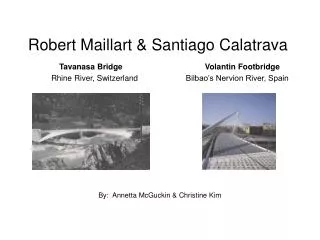
Robert Maillart & Santiago CalatravaTavanasa BridgeVolantin Footbridge Rhine River, Switzerland Bilbao’s Nervion River, Spain By: Annetta McGuckin & Christine Kim
Though Calatrava and Maillart differ in many ways they share a similar visual aesthetic that has placed them among the most innovative of bridge builders. Thesis Statement
Robert Maillart • Scientific/efficiency • Realized that he could correct the problem of cracking in the reinforced concrete by subtracting an area in the spandrel walls nearest to the abutments • Social/economic • The bridge was a success economically because it omitted the masonry facing, and used less material and construction costs were less overall • Symbolic/Elegance • Though the bridge faced widespread criticism at the time, it was an innovative form and is considered a piece of structural art • It was symbolic of changes in structural engineering and reinforced concrete and showed that technology was moving forward
Santiago Calatrava • Scientific/efficiency: • A parabolic tied arch consisting of a steel grid, composed of forty-one I-shaped ribs with glass flooring that supports the steel profiles. • Social/economic: • The Volantin Footbridge was built for a vast campaign of urban renewal. • Symbolic/elegance: • The fixed lights on the bridge makes it look like a sculpture that brings the community together and a pedestrian meeting place. • He derived his design from a harp in which the suspension cables on the bridge represent the strings and the cut outs make it seem light and elegant.
Conclusion At first glance one would think that Calatrava’s structure, the Volantin Footbridge, is based on Maillart’s bridges. The visual aesthetics of Maillart’s and Calatrava’s structures are similar, but the differences in the environment, cost, and materials are what sets these structural engineers apart. Although they were structural engineers at different periods in time they were both innovative pioneers in their field.