Download
1 / 5
50 likes | 168 Vues
The 22Ne(α,n)25Mg reaction is crucial as the main neutron source for the s-process, responsible for forming nuclides heavier than iron. To advance our understanding, we will investigate this direct reaction while also measuring competition from the 22Ne(α,γ)26Mg process. Our focus is on low-energy regions where the Coulomb barrier impacts reaction rates significantly. We aim to determine the quantum numbers of pertinent resonances in 26Mg, requiring precise data on resonance positions, widths, and strengths through advanced detection configurations.

E N D
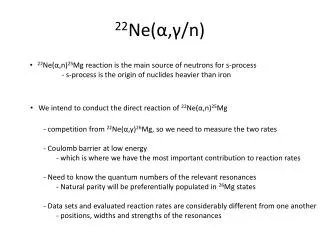
22Ne(α,γ/n) • 22Ne(α,n)25Mg reaction is the main source of neutrons for s-process • - s-process is the origin of nuclides heavier than iron • We intend to conduct the direct reaction of 22Ne(α,n)25Mg • competition from 22Ne(α,γ)26Mg, so we need to measure the two rates • Coulomb barrier at low energy - which is where we have the most important contribution to reaction rates • Need to know the quantum numbers of the relevant resonances - Natural parity will be preferentially populated in 26Mg states • Data sets and evaluated reaction rates are considerably different from one another • - positions, widths and strengths of the resonances
Detector Configuration • Anti-coincidence (veto) configuration to suppress cosmic-ray-induced background • At least, we need four detectors, so that we can do angular distributions • - In order to get the Quantum number of the resonances • - DWBA calculations to constraint the spins