Download
1 / 14
140 likes | 319 Vues
This document explores various methods of forensic identification, including classical and DNA techniques, focusing on their applications in solving cases of death and identifying individuals. Key areas include morphological characteristics, fingerprint analysis, dental records, and DNA profiling. The analysis discusses the significance of individual traits such as height, hair color, and facial features, alongside the critical role of DNA in ensuring accurate identification. Additionally, techniques for recognizing decomposed remains and the impact of mass disasters on forensic investigations are examined.

E N D
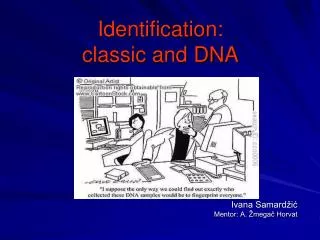
Identification:classic and DNA Ivana Samardžić Mentor: A. Žmegač Horvat
...of the living and the dead • investigation of any death • the living – inability to identify themselves, immigration, inheritance
Morphological characteristics • only by MATCHING the parameters • specific feature possesed by the individual • height, weight and general physique • hair color and length, moustache, skin pigmentation, eye color • clothing, jewellery, ornaments • facial appearance, age
Fingerprints • position of minute defects on the ridges • no less than 16 points of similarity • chances for identical fingerprint: 1:64 billion
Identity from teeth • identification of the dead, bite marks, estimation of age • commonly comparison of antemortem dental chartings with the direct examination of the teeth • mass disasters • no previous records – age, sex and ethnic origin
Identification of the origin of tissue or samples • blood, semen, saliva, stains on bodies, weapons, clothing • matching remains • resolution of paternity, maternity and inheritance disputes
The individuality of cells • blood grups and Rh factor – possibility to exclude 93% of non-matching samples • replaced with DNA analysis of human tissue and fluid
Identification by DNA profiling • nearly 100% in exclusion and in identification • 10% are active genes • 90 % are “silent” – zone of 200 to 14 000 repeats of identical sequences of bases are constant and transmitted from parents – ESSENTIAL for DNA analysis! • “bar code”
risk of contamination • blood, hair with roots; samples of spleen; buccal smears; vaginal, anal and penile swabs • paternity/maternity testing • every bar in the “bar code” must have come from either the father or mother, half from each
Tatoos and body piercing • there has to be comparison • photographs and drawings if visual identification is not possible
Identity of decomposed or skeletalized remains • are the remains actually bones? • are the remains human? • one or more bodies? • what sex are the bones? – pelvis and skull • age, height, race? • can a personal identity be discovered? • YouTube - Crime 360: Human Bone Identification
Facial reconstruction from skulls • measuring the average soft-tissue thickness at many points on the skull and rebuilding this layer with plasticine on unknown skull • computerized reconstruction • individuality of faces? • what about eyes and lips?