Exploring High-Pressure Ice Phases: Insights from Cornell University
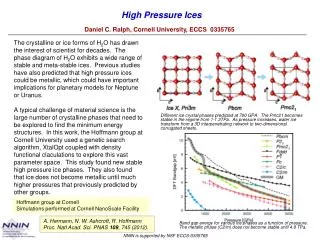
This study by the Hoffmann group at Cornell University investigates the crystalline phases of high-pressure ice (H2O) using advanced computational methods. Employing a genetic search algorithm combined with density functional calculations, the research explores the vast parameter space of ice structures. Findings reveal new stable high-pressure ice phases and indicate that the transition to metallic ice occurs at pressures much higher than previously predicted. Notably, the discovery of different ice crystal structures at 700 GPA and the stability of the Pmc21 phase between 1-1.3 TPa provides significant implications for understanding planetary models of ice giants like Neptune and Uranus.

Exploring High-Pressure Ice Phases: Insights from Cornell University
E N D
Presentation Transcript
High Pressure Ices Daniel C. Ralph, Cornell University, ECCS 0335765 The crystalline or ice forms of H2O has drawn the interest of scientist for decades. The phase diagram of H2O exhibits a wide range of stable and meta-stable ices. Previous studies have also predicted that high pressure ices could be metallic, which could have important implications for planetary models for Neptune or Uranus. A typical challenge of material science is the large number of crystalline phases that need to be explored to find the minimum energy structures. In this work, the Hoffmann group at Cornell University used a genetic search algorithm, XtalOpt coupled with density functional claculations to explore this vast parameter space. This study found new stable high pressure ice phases. They also found that ice does not become metallic until much higher pressures that previously predicted by other groups. Different ice crystal phases predicted at 700 GPA. The Pmc21 becomes stable in the regime from 1-1.3TPa. As pressure increases, water ice transform from a 3D interpenetrating network to two-dimensional corrugated sheets. Hoffmann group at Cornell Simulations performed at Cornell NanoScale Facility A. Hermann, N. W. Ashcroft, R. Hoffmann Proc. Natl Acad. Sci. PNAS 109, 745 (2012). Band gap energy for various ice phases as a function of pressure. The metallic phase (C2/m) does not become stable until 4.8 TPa.