Download
1 / 40
400 likes | 535 Vues
This research explores the profound implications of strong-field physics on chemistry through advanced time-domain spectroscopy. Utilizing femtosecond laser pulses, phenomena like nuclear motion and tunneling ionization in molecules are analyzed. The aim is to achieve quantum tomography from united to separated states of atoms, with a focus on diatomic molecules and their ionization processes. The study highlights innovative techniques such as resonant excitation and pump-probe methods to examine molecular dynamics, emphasizing their importance in understanding complex phenomena in strong fields.

E N D
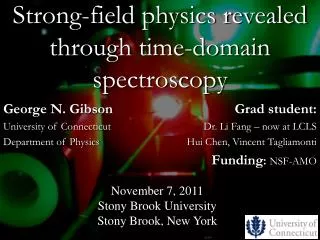
Strong-field physics revealed through time-domain spectroscopy George N. Gibson University of Connecticut Department of Physics Grad student: Dr. Li Fang – now at LCLS Hui Chen, Vincent Tagliamonti Funding: NSF-AMO November 7, 2011 Stony Brook University Stony Brook, New York
What can strong-field physics offer chemistry? • Time resolution: femtosecond laser pulses can resolve nuclear motion, R • Can control both R and • Can look at processes as a function of both • Ultimate goal: Quantum tomography as a function of R – united atom to separated atom Start with: End with:
2-D 1-electron double-well gwavefunctions: Increasing internuclear separation:
Back to Basics:Tunneling ionization of a double-well potential(All strong field experiments on molecules start here!)Ionization is dominated by an effect called “R-critical ”
10 5 0 5 10 U1 , j 0 Basic Tunneling Ionization: This separation is called “Rcritical” (Bandrauk, Seideman, Corkum, Ivanov)
Dynamics of 1 electron in field: Unified atom limit Dipole moment
Intermediate case. Strongly driven gerade ungerade transition creates large dipole moments, compared to atoms or even-charged ground state molecules.
Data and calculations for H2+: Better: Zuo and Bandrauk, PRA (1995), Data: Gibson et al., PRL (1997) End of story? This is from an ion. Also, not pump-probe, so a number of assumptions were made.
Simple model for Rc • For H2+, Rc should be 3/(0.5) = 6, which is close. • Want to test in the neutral using pump-probe, since most experiments start in the neutral species. Find condition where the inner barrier just equals the energy of the ground state:
Resonant excitation provides a mechanism for studying the neutral Using pump-probe techniques, we can control R. Resonant excitation follows a cos()2 pattern, producing a well-aligned and well-defined sample. This gives: <cos()2> = 0.6at room temperature with one laser pulse. [For unaligned samples <cos()2> = 0.33]
Laser System • Ti:Sapphire 800 nm Oscillator with a Multipass Amplifier • 750 J pulses @ 1 KHz • Transform Limited, 30 fs pulses • TOPAS Optical Parametric Amplifer: 490nm – 2000nm
Vibrational period (fs) X-B coupling wavelength (nm) Wavepacket motion in the B-state of I2 gives <R>(t)
Ionization vs. R • We know <R(t)> from the motion on the B state. • Can convert from time to R(t).
IpRc = 3.01 Wavelength check: Shorter wavelength: larger outer turning point longer vibrational period
Really want to study the ground state! • Can we return the wavepacket to the X-state? • Yes, with a pump-dump scheme:
Returning wavefunction in X-state (2,1) (2,0)
Diatomic molecules in strong fields: N2+ + N0+ (15.1 eV) N3+ + N1+ (17.8 eV) N4+ + N2+ (30.1 eV) • N2 N21+ N22+ N1+ + N1+ N23+ N1+ + N2+N24+ N2+ + N2+N25+ N3+ + N2+N26+ N3+ + N3+ N27+ N4+ + N3+
Why is the observation of Charge-Asymmtric Dissociation so important? • It represents direction excitation of states with energies in the VUV spectral region. (Up to 30eV in N26+). • Excitation involves many photons. • Have seen everything up to I212+ I5+ + I7+. • Optimizing excitation process may lead to amplifiers in the VUV as inversions are likely occurring. • May be a new high-harmonic source. • CAD is a ubiquitous and robust process:There must be something generic about the structure of homonuclear diatomic molecules.
What is so special about (even) charged diatomic molecules? Ground state is a far off-resonant covalent state. Above this is a pair of strongly coupled ionic states. Only a weak coupling between them.
3-Level Model System This system can be solved exactly for the n-photon Rabi frequency!
Three-level systems: “V”: “”: Now the “”:
Diatomic Dications • How are asymmetric states populated? Is it through multiphoton transitions in the -system? • (2,0) must have binding. In fact, it is an excimer-like system, bound in upper state, unbound in lower state. Can we trap population in this state? • Can we make a multiphoton pumped excimer laser? • We have evidence for bound population. • Evidence for 3- excitation – but is it due to the structure???
Need spectroscopic information • Namely, there should be (2,0)g and (2,0)u. • TOF spectroscopy not sensitive enough to distinguish them. • However, coherent 12 fields provide an interesting spectroscopic tool.
What are 12 fields? If you add a fundamental laser frequency and its second harmonic, you can break spatial symmetry.
Molecular dissociation • Charge-asymmetric dissociation is generally spatially symmetric (with a single frequency pulse).I.e., for I2+ + I, the I2+ goes to the left as much as to the right. • However, with a spatially-asymmetric laser field can break the spatial symmetry of the dissociation.
Molecular dissociation,with a 12 field Phase = 0 Phase = /2
Eigenstates vs. Observables • Observable: I2+ + I (2,0) or (0,2) (left or right) • Eigenstates: (2,0)g ~ (2,0) + (0,2) (2,0)u ~ (2,0) – (0,2) • Eigenstates must dissociate spatially symmetric. Therefore, a spatial asymmetry requires a coherent superposition of g and u states, which is only possible in a spatially asymmetric field.
Simple tunneling model • g and u states strongly coupled – diagonalize in a dc field. • Assuming ionization into the lowest lying (down field) level. • Project back onto field-free states and calculate spatial asymmetry.
Spatial asymmetry as a function of R • We can measure the spatial asymmetry of the (2,0) dissociation channel by populating the B-state of I2.
What do we learn from 12 fields? • In strong-field ionization, it appears that the field induced states are populated directly through tunneling ionization. • It is not the case that ionization populates the ground state and the asymmetric states are then populated through the -system. (Very difficult to reproduce the spatial asymmetry dependence.) • Really must consider the field-induced molecular structure to understand strong-field ionization. • Also, raises interesting questions about decoherence and dephasing.
Conclusions • Strong fields offer unprecedented control over t, R, and . • We also have considerable control over nuclear wavepackets. • Can measure strong field processes as a function of these variables. • Can investigate the structure of unusual (highly ionized) molecules.