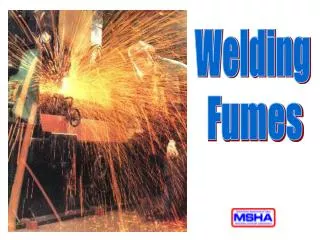

Welding Fumes: Health Hazards and MSHA Regulations
E N D
Presentation Transcript
Welding Fumes
Welding Fumes • What Are Welding Fumes ? • Health Hazards • MSHA Regulations • Sampling Methods • Controls
Welding Fumes • What Are Welding Fumes ? • Health Hazards • MSHA Regulations • Sampling Methods • Controls
What Are Welding Fumes ? • Welding Causes Solid Metal To Vaporize • As Vaporized Metal Cools, It Condenses To Reform As Solid Particles - FUME • Fumes Are Very Small Particles - - Usually Much Smaller Than Dust • Dust Usually Larger Than 1 Micron • Fumes Can Be As Small As 1/1,000 Micron • Unless Captured And Removed, Fumes Remain Suspended In Air Indefinitely
How Big Is A Micron ? Head of Pin 1/32 Inch
How Big Is A Micron ? 20 Microns Head of Pin 1/32 Inch
Size Comparison of Small Particles m Washed Foundry Sand 200 to 2,000 Plant Spores 10.0 to 40 Red Blood Cells 7 Cement Dust 1.0 to 10 Bacteria 1/10 to 10 Tobacco Smoke 1/100 to 1/2 Metal Fumes 1/1,000 to 1.0
Composition of Welding Fumes • Composition Varies Depending On: • Material Being Welded • Welding Process, Rod, Electrode Type • Obtain MSDS From Manufacturer • Typical Welding Fume Constituents: • Aluminum, Cadmium, Chromium, Iron, Moly • Cobalt, Copper, Zinc, Manganese, Tin, Lead • Nickel, Arsenic, Mercury, Vanadium, • Beryllium, Magnesium, Titanium, • May Be Metal or Oxide
Welding Fumes • What Are Welding Fumes ? • Health Hazards • MSHA Regulations • Sampling Methods • Controls
Exposure Primarily By Inhalation Fumes Are 100% Respirable What Does “Respirable” Mean ?
Exposure Primarily By Inhalation Fumes Are 100% Respirable What Does “Respirable” Mean ?
Welding Fume Toxicity • Acute Toxicity • Exposure To High Concentration Over Relatively Short Time • Symptoms Appear Relatively Quickly After Exposure • Chronic Toxicity • Exposure To Lower Concentration Over Long Time (Months, Years) • Symptoms Appear Long After Initial Exposure
Welding Fume Toxicity Kidney Nervous Liver GI Lung Aluminum X X Beryllium X Cadmium X X X X Chromium X X X X Cobalt X X X Copper X X Iron X X X X Lead X X X Manganese X X Nickel X X Zinc X X
Welding Fume Toxicity • Exposure Usually Involves More Than One Metal • Toxic Effects May Be Additive • Examples • Blood - Manganese and Lead • CNS - Manganese and Lead • Kidney - Lead and Cadmium • Respiratory System - Magnesium, Manganese, Copper, and Zinc
Welding Fume Toxicity • Metal Fume Fever • Symptoms Are Fever, Chills, Shaking • Symptoms Appear 4-12 Hrs After Exp. • Recovery Usually Within 1 Day • Usually Associated With Brief High Inhalation Exposure To Zinc, But Magnesium & Copper Also May Cause • Daily Exposure May Confer Immunity • Symptoms May Return If Exposure Interrupted (3-Day Weekend)
Welding Fume Toxicity • Welding Fumes Can Cause Cancer • Arsenic (Lung, Lymphatic) • Beryllium (Lung) • Cadmium (Prostatic and Lung) • Chromium (Lung) • Nickel (Lung) • Welders May Also Be Exposed To: • Silica, Asbestos, Ozone • Thermal Decomposition of Paint, Flux, Electrode Coatings (CO, CO2, NO, NO2, HCN, COCl2, Fluoride Gases, Smoke, Etc.)
Welding Fumes • What Are Welding Fumes ? • Health Hazards • MSHA Regulations • Sampling Methods • Controls
MSHA Regulations § 56/57.5001 Establishes Exposure Limits For Airborne Contaminants • TWA8 And Ceiling Limits Listed In 1973 ACGIH Booklet of Threshold Limit Values (TLV’s) • TWA8 Time Weighted Average For 8 Hrs • Ceiling Limits Cannot Be Exceeded For Any Length Of Time • ACGIH 1973 TLV Booklet References 1968 “PA Rules” For Short Term Limits
Exposure Limits For Common Welding Fumes TWA8 Short Term Beryllium 2.0 g/m3 25.0 g/m3 Magnesium Oxide 10.0 mg/m3 20.0 mg/m3 Vanadium 50.0 g/m3 50.0 g/m3 Chromium 1.0 mg/m3 3.0 mg/m3 Manganese (C) 5.0 mg/m3 5.0 mg/m3 Nickel 1.0 mg/m3 3.0 mg/m3 Cobalt 100.0 g/m3 500.0 g/m3 Zinc Oxide 5.0 mg/m3 10.0 mg/m3
Milligrams or Micrograms Per Cubic Meter of Air mg or g 1 meter 1 meter 1 meter 1 milligram = 1/1,000 gram = 35/1,000,000 oz 1 microgram = 1/1,000,000 gram = 35/1,000,000,000 oz
How Much is 100 g/m3 ? 100 g/m3 = 0.1 ounce per 1,000,000 ft3
MSHA Regulations §56/57.5002Dust, Gas, Mist, And Fume Surveys Shall Be Conducted As Frequently As Necessary To Determine The Adequacy Of Control Measures §56/57.5005Control of Harmful Airborne Contaminants Shall Be, Insofar As Feasible, By Engineering Controls • Respirators Permitted Under Certain Circumstances
MSHA Regulations Part 46 and Part 48 Training §56/57.14213(b) All Welding Operations Shall Be Well Ventilated §56/57.20011Areas Where Health or Safety Hazards Exist That Are Not Immediately Obvious Shall Be Barricaded Or Warning Signs Posted
Welding Fumes • What Are Welding Fumes ? • Health Hazards • MSHA Regulations • Sampling Methods • Controls
Sampling Methods • For Compliance With §56/57.5001 And §56/57.5002 • Full Shift Or Short Term
Sampling Methods • For Compliance With §56/57.5001 And §56/57.5002 • Full Shift Or Short Term • Sample Pump, Pump Calibrator, Filters
Sampling Methods • For Compliance With §56/57.5001 And §56/57.5002 • Full Shift Or Short Term • Sample Pump, Pump Calibrator, Filters • Place Filter In Breathing Zone Under Hood
Sampling Methods • For Compliance With §56/57.5001 And §56/57.5002 • Full Shift Or Short Term • Sample Pump, Pump Calibrator, Filters • Place Filter In Breathing Zone Under Hood • Pump Draws Air Over Filter; Contaminants Captured On Filter
Sampling Methods • Analytic Lab Determines Weights Of Individual Contaminants On Filter • Weights Converted To Concentrations
Sampling Methods • Analytic Lab Determines Weights Of Individual Contaminants On Filter • Weights Converted To Concentrations weight of contaminant volume of air
Sampling Methods • Analytic Lab Determines Weights Of Individual Contaminants On Filter • Weights Converted To Concentrations weight of contaminant mg or g volume of air m3
Sampling Methods • Analytic Lab Determines Weights Of Individual Contaminants On Filter • Weights Converted To Concentrations weight of contaminant mg or g volume of air m3 • Measured Concentration Compared To Established Exposure Limit
Sampling Methods • Analytic Lab Determines Weights Of Individual Contaminants On Filter • Weights Converted To Concentrations weight of contaminant mg or g volume of air m3 • Measured Concentration Compared To Established Exposure Limit • Measured Less Than Limit - - No Action Req’d
Sampling Methods • Analytic Lab Determines Weights Of Individual Contaminants On Filter • Weights Converted To Concentrations weight of contaminant mg or g volume of air m3 • Measured Concentration Compared To Established Exposure Limit • Measured Less Than Limit - - No Action Req’d • Measured Over Limit - - Implement Controls
Welding Fumes • What Are Welding Fumes ? • Health Hazards • MSHA Regulations • Sampling Methods • Controls
Controls (§56/57.5005) • Feasible Engineering Controls • Personal Protective Equipment (PPE) • PPE Allowed As Means Of Compliance Only In Limited Situations • Where Feasible Engineering Controls Do Not Exist • While Installing Engr. Controls • Occasional Entry Into Hazardous Atmosphere For Maintenance
Engineering Controls • General Ventilation • Natural or Mechanically Induced (Fans) Airflow Over Work Area That Dilutes and Carries Away Contaminants • Local Exhaust Ventilation • Captures and Removes Airborne Contaminants Before They Escape Into Workplace Air • Local Exhaust Always Preferred For Toxic Airborne Contaminants
General Ventilation • Outdoors - Wind • Indoors • Open Shop Doors/Windows • What Blows In, Must Blow Out • Fans • Fixed - Roof, Walls, Windows • Portable • Blow Fresh Air Into Work Area, But Don’t Blow Fumes Into Welder’s Breathing Zone • Push-Pull Fan Arrangements • Need Provision For “Make Up” Air
Local Exhaust Ventilation • Capture Hood & Fixed Duct System
Local Exhaust Ventilation • Portable “Fume Eliminator”
Local Exhaust Ventilation • Down Draft Table
Local Exhaust Ventilation • System Must Have Adequate Air Velocity To Draw In Fume Particles • Minimum Capture Velocity 100 ft/min • Better To Design For 200 ft/min • May Need Provision For “Make Up” Air • 10” Round Duct Drawing 200 ft/min • Air Volume Removed From Work Area Is 110 cfm
Local Exhaust Ventilation • Must Position Hood Correctly • Air Velocity Drops Rapidly With Distance Away From Hood Opening
Local Exhaust Ventilation • Must Position Hood Correctly • Air Velocity Drops Rapidly With Distance Away From Hood Opening Hood Opening 10 inches Airflow 10“ 200 120 60 15 Air Velocity (ft/min)
1350 fpm 100 fpm
Respiratory Protection • Air Purifying Or Supplied Air • May Be Integral With Welding Hood • Respirator Use Must Include Implementation of Respiratory Protection Program (See ANSI Z88.2-1969) • Written Procedures on Selection and Use • Respirator Training and Fit Testing • Respirator Inspection, Cleaning, Storage • Workplace Surveillance • Medical Evaluation Recommended
Welder’s Powered Air Purifying Respirator (PAPR) Half-Mask Cartridge Respirator Supplied-Air Respirator