Key Compromises in the Formation of the U.S. Government
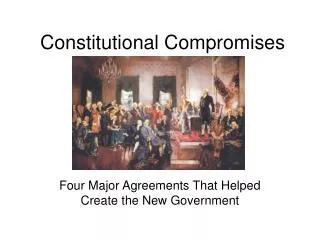
The Constitutional Convention in Philadelphia saw critical compromises between states to form a new government structure. The Virginia Plan proposed a strong national government favoring larger states, while the New Jersey Plan called for equal representation among states. The Connecticut Compromise established a bicameral Congress with one house based on population and the other on state equality. Additionally, the 3/5ths Compromise addressed the contentious issue of counting enslaved individuals for representation, allowing three out of every five slaves to be counted.

Key Compromises in the Formation of the U.S. Government
E N D
Presentation Transcript
1. Delegates met in Philadelphia. A. Virginia Plan 1. The Virginians called for a wholly new government structure, composed of a strong three branched national government empowered to lead the nation. -Favored large states. -written by James Madison
B. New Jersey PlanNew Jersey Plan 1. Called for representation in Congress to be on the basis of state equality as it had been in the Articles of Confederation, not according to size and financial contribution. -Written by James Patterson
C. Connecticut Compromise 1. The Congress would be bi-cameral. 2. One house would be based on population. 3. One house would be based on state equality. 4. This is often called the “greatcompromise.”
3/5ths Compromise 1. Congress was in part made up of population. 2. Some states felt that slaves should not be counted in Southern Sate population.
3. The south felt that slaves were not people in regular terms, and that so the Northern states did not think that the South should be allowed to count them as such in Congress 4. A compromise was reached, and three of every five slaves were allowed to be counted in a states population for Congressional representation purposes.