Download
1 / 6
70 likes | 222 Vues
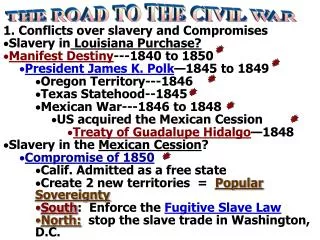
The Missouri Compromise, a pivotal legislative agreement led by figures like Henry Clay, admitted Missouri as a slave state and Maine as a free state, while banning slavery in the Louisiana Territory north of the 36°30' line. However, this compromise was later deemed unconstitutional in the Dred Scott decision, exacerbating tensions between the North and South. The subsequent Kansas-Nebraska Act introduced the concept of popular sovereignty, allowing settlers to determine the fate of slavery in Kansas and Nebraska, which led to conflict and division in the nation.

E N D
Compromises on slavery Hannah Hayes, Yvonne Arias, Hunter Burt, Luker Hays, Roland Echols
Missouri Compromise • Leaders: Henry Clay, Dred Scott and Thomas Jefferson • Admitted Missouri as a slave state and Maine as a free state. The law banned slavery in the Louisiana Territory north of the 36 degree 30 degree latitude line. Three years later it was declared unconstitutional in the Dred Scott decision. • Significance: The tension and division between the North and the South was heightened.
Kansas Nebraska Act • Leaders: Stephen Douglas & Franklin Pierce • Divided the land into two territories, Kansas and Nebraska. It was up to the people to decide if they wanted slavery in their territory. However, the Missouri Compromise outlawed slavery in the two territories. On May 30, 1854