
Towards Zero Carbon
E N D
Presentation Transcript
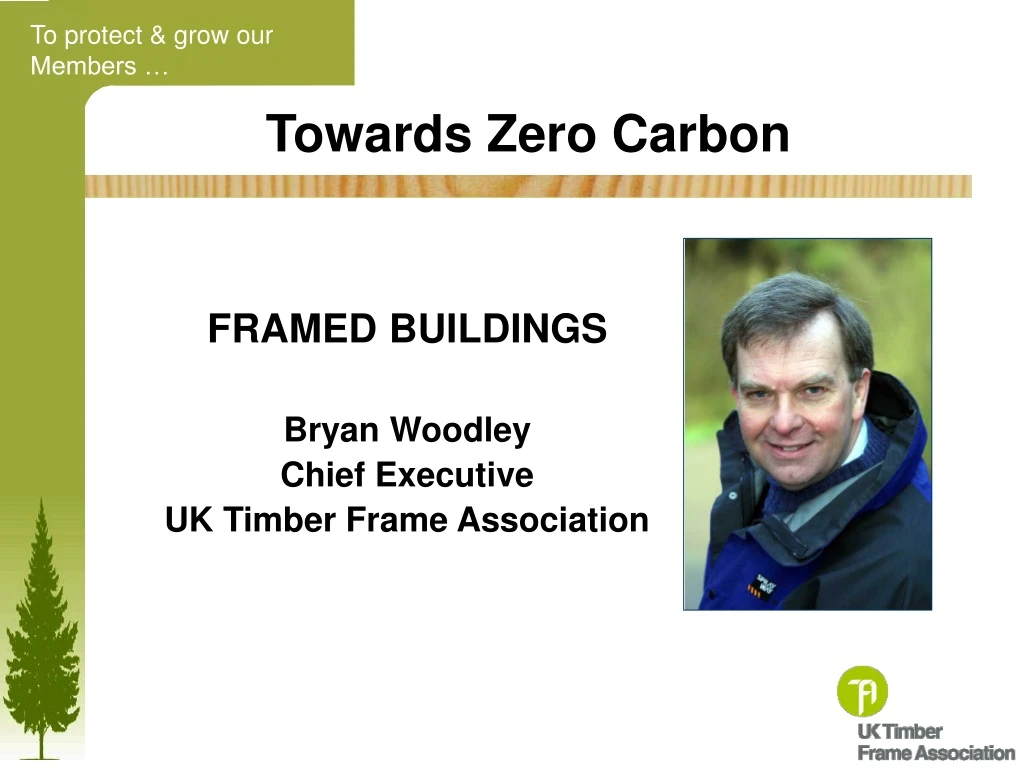
Towards Zero Carbon FRAMED BUILDINGS Bryan Woodley Chief Executive UK Timber Frame Association
Framed Buildings • Background • Strategy • Code for Sustainable Homes • Addressing the Key Factors • Current Status • The Learning Outcomes
Timber Frame UK Market Share of New Housing 14% England & Wales Timber Frame Market Share
Background • Energy Review & Legislative Drivers • Sustainable Buildings Task Group • Code For Sustainable Homes • Real Improvements in: • CO2 Emissions • Water Use • Level 1 – Just Above 2006 Building Regulations • Level 6 – “Net Zero Carbon” • Fiscal Incentives – Stamp Duty
Framed Buildings - Strategy • Sustainability • Climate Change • Net Zero Carbon • Affordability • First time buyers • Key workers • Demographic aspects • Homes that People Want to Live In
Tomorrows World • 32 vs 20 Sockets Per Household • 80 Litres of Water / Person / Day • 4.4m Single Person Households • More Extended / Elderly Families • Sustainable Urbanism • Daily needs within 5 minute walk • Mixed income/use neighbourhoods • Physically defined & accessible public spaces, etc.
Framed Buildings – Net Zero Carbon • The Code for Sustainable Homes: • 9 Assessment Categories • 6 Different Ratings • Building Regulations Timeframe
Ratings 1(*) 2(**) 3(***) 4(****) 5(*****) 6(******) • CO2 (% imp) • - 10% • 18% • 25% • 44% • 100% • zero carbon • Water (l/p/d) • - 120 • 120 • 105 • 105 • 80 • 80 Framed Buildings – Net Zero Carbon • The Code for Sustainable Homes: • 6 Different Ratings
CO2 (% imp) • - 10% • 25% • 44% • zero carbon Rating 1(*) 3(***) 4(****) 6(******) Year 2008 2010 2013 2016 Framed Buildings – Net Zero Carbon • The Code for Sustainable Homes: • Building Regulations Timeframe
Minimum standards at each code level Minimum standards at code entry level No minimum standards Framed Buildings – Net Zero Carbon • The Code for Sustainable Homes: • 9 Assessment Categories • Categories • - Energy/ CO2 • Water • Materials • Surface water run off • Waste • Pollution • Health/ well being • Management • Ecology
Addressing the Issues - Energy / C02 • Twofold strategy: • Maximise building fabric performance standards • Then offsetting emissions using micro- renewables
Energy / C02 - Walls (U-values) • 0.35 W/m2K - minimum Building Regulations • 0.30 W/m2K - standard 140 mm stud + basic insulation • 0.27 W/m2K - standard 140 mm stud + better insulation • 0.25 W/m2K - above + reflective breather membrane • 0.21 W/m2K - above + reflective vcl + service void (generic) • 0.15 – 0.14 W/m2K - advanced versions of above (proprietary) • 0.11 W/m2K - high performance sips (proprietary)
Energy / C02 - Building Envelope • High performance walls, floors, roofs • Windows 0.7 W/m2K (incl. wooden frame) triple glazed, gas filled • Heat Load Parameter (U-Value for the whole building) = 0.8 W/m2K or better (SAP) • Key factor to achieve 6 stars under the Code
Energy / C02 - Air leakage • ‘Reasonable Limit’ of 10 m³/(h.m²) in BR’s • Standard timber frame 5 - 8 m³/(h.m²) • < 5 m³/(h.m²) – detail attention to vcl • < 2.5 m³/(h.m²) – service zone • 1 m³/(h.m²) for Code 5 & 6 • Mechanical ventilation with heat recovery • Lighthouse 88% heat recovery
Energy / C02 - Overheating • 70% of developed world lives in TF homes • Consideration of solar gain & ventilation • BRE study - standard modern masonry, steel & timber frame have similar thermal mass • Thermal mass - passive & active • Oak Ridge National Laboratory research: • Good contact with building interior • Active phase change material • Install as 8mm panels behind pboard • Reduces temperature peaks by up to 7oC
Minimising Summer Heating • Large secure ventilation openings that occupants feel safe leaving open at night and away from home • Modest sized windows • Solar shading, with future upgrade sufficient to stop 90% of direct solar gain • Low energy appliances (hence low heat emitting) • ‘Thermally heavyweight’ room surfaces to absorb daytime heat gains and provide natural cooling • Purge ventilation to remove at night the heat absorbed by the room surfaces during the day
3 wind turbines 4 solar hot water panels 17m2 photovoltaic panels Offset Emissions - Micro- Renewables • Solar hot water panels • Photovoltaic panels – Lighthouse: 4.7kW • Wind turbines – 3 on Sigma House • Automatic wood pellet boiler • Wood pellet store
Materials – Category 3 • Mat 1 – materials with lower environmental impact • Green Guide rating • Roofs & walls at A+ rating & walls at A rating • Credits of 10 = 2.7 Code point score • Windows A or A+ rating = total 13 = 3.6 Code points • Mat 2 - responsible sourcing • Timber certified responsibly sourced • Tier 1 FSC & PEFC for 4 out of 8 areas • Max 3 points per element = 12 = 1.2 Code points
Health & Well Being – Category 7 • Daylight • Sound insulation • Private space • Lifetime Homes
Category 7 - Sound Insulation • Party Walls • Stewart Milne Sigma House • Conventional RD party wall construction • Addition of 25mm and 50mm service voids • Enhanced acoustic performance • 8dB uplift on Part E • Maximum credits
Category 7 - Sound Insulation • Floors • Stewart Milne Sigma House • Separation of Live/Work Unit • Slotted joist technology • Acoustic separation • Floor and ceiling • Factory installed insulation • Integral 109mm service void • Candidate Robust Detail
Assessment Process • Design Stage Assessment • Post Construction Review • Evidence based assessment
Stewart Milne - The Sigma House • A pair of 4 storey, semi open plan terraced town houses, with a split level interior • Achieves a 5*/6* Code rating • Near zero carbon emissions • 100%+ performance improvement over Building Regulations • Integrated micro- renewables • High density family housing • Flexible interior spaces • Closed timber frame panels and steel framed bathroom pods
Kingspan Lighthouse • The world’s first Level 6 Net-Zero Carbon House. • The sweeping roof envelopes the central space which is a generous, open plan, top lit, double height living space with the sleeping accommodation at ground level • The living space uses a timber portal structure • Uses Kingspan TEK system with U-values of 0.11 W/m2K & air permeability of 1 m3/h/m2 • Technology includes mechanical ventilation with 88% heat recovery, photovoltaics, automatic wood pellet boiler & solar hot water panels • Water reduction is achieved with low usage showers, water labelled A++ white goods, greywater recycling, etc. • A smart meter records energy consumption
Current Status • Framed buildings provide a basis for the Code • Code Levels 1*,2* & 3* can be delivered now with limited change to current best practice • Code Levels 4*,5* & 6* can also be produced now but require challenges to the current approach and mindset • The more demanding Levels involve an increasing cost premium ~ 40% for Level 6
The Learning Outcomes • Challenging current approach and mindset • Early supplier integration is key • Management of micro energy supply • Focus on the customer • Cost of technology and new components & materials • Ability to manage change
Any questions or comments please? Thank you for your attention Bryan Woodley Chief Executive UK Timber Frame Association