ASIM Mission: Studying Thunderstorms and Climate Interactions from Space
10 likes | 133 Vues
The Atmospheric Space Interaction Monitor (ASIM) aims to explore extreme thunderstorms and their coupling to the upper atmosphere and space, focusing on factors like electrical discharges between clouds and the ionosphere, the generation of X- and Gamma-rays, and aerosol transport affecting climate. Developed by DTU Space with the European Space Agency (ESA) and various international partners, ASIM will be launched aboard the ISS. This mission, costing approximately 150 million DKK, will enhance understanding of the natural phenomena influencing Earth's climate and weather systems.


ASIM Mission: Studying Thunderstorms and Climate Interactions from Space
E N D
Presentation Transcript
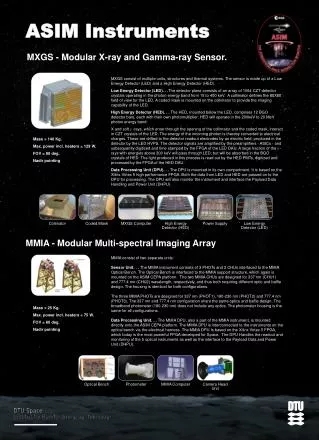
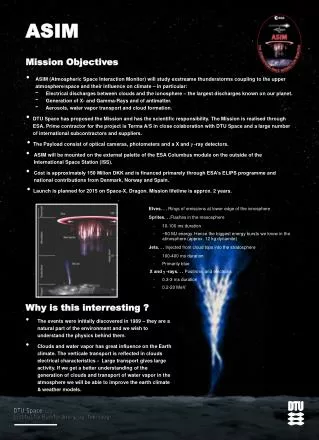
ASIM Mission Objectives • ASIM (Atmospheric Space Interaction Monitor) will study exstreame thunderstorms coupling to the upper atmosphere/space and their influence on climate – in particular: • Electrical discharges between clouds and the ionosphere – the largest discharges known on our planet. • Generation of X- and Gamma-Rays and of antimatter. • Aerosols, water vapor transport and cloud formation. • DTU Space has proposed the Mission and has the scientific responsibility. The Mission is realised through ESA. Prime contractor for the project is Terma A/S in close colaboration with DTU Space and a large number of international subcontractors and suppliers. • The Payload consist of optical cameras, photometers and a X and -ray detectors. • ASIM will be mounted on the external palette of the ESA Columbus module on the outside of the International Space Station (ISS). • Cost is approximately 150 Milion DKK and is financed primarely through ESA’s ELIPS programme and national contributions from Denmark, Norway and Spain. • Launch is planned for 2015 on Space-X, Dragon. Mission lifetime is approx. 2 years. • Elves. . . Rings of emissions at lower edge of the ionosphere • Sprites. . .Flashes in the mesosphere • 10-100 msduration • ~50 MJ energy. Hence the biggest energy bursts we know in the atmosphere (approx. 12 kg dynamite) • Jets. . . Injected from cloud tops into the stratosphere • 100-400 msduration • Primarily blue • X and -rays. . . Positrons and electrons • 0.3-3 ms duration • 0.2-20 MeV • Why is this interresting ? • The events were initially discovered in 1989 – they are a natural part of the environment and we wish to understand the physics behind them. • Clouds and water vapor has great influence on the Earth climate. The verticale transport is reflected in clouds electrical characteristics - Large transport gives large activity. If we get a better understanding of the generation of clouds and transport of water vapor in the atmosphere we will be able to improve the earth climate & weather models.