
Mastering Lighting Techniques in Video Production
E N D
Presentation Transcript
Types of Light • Incident: comes directly from the light source • Reflected: has come in contact with some other material before entering our field of vision • Our ability to see largely the result of reflected light
Lighting Director’s Goals • Meet artistic needs of the program • General Illumination needs • Develops a lighting plan so that all performers and parts of the set are lit as required/desired
Measuring Light Levels • Measured with a light meter • Video levels? Audio levels? • In footcandles (ftc)--amount of light falling on a surface one foot from the light with the illumination level of one candle • Also used, lux: About 10 lux = 1 ftc • Measure incident & reflected
Other lighting issues • 1--Contrast Ratio: brightest to darkest: human eye 100:1, TV 30:1 • Sports Stadium daytime shots (shader) • Monitors and adjusts the iris opening • AGC automatically adjusts • 2--Color Temperature: measure of the frequency of the light wave • 3,200° K / 5,400° K / red / blue
Lighting uses & objectives • Flat Lighting (shape/texture) • High-key / low-key for mood • Follow spot, limbo (subject ‘in limbo’ against softly lit cyc/cameo (subject lit & background dark)/ silhouette (subject dark & background lit)lighting-focus attn. More specific definition to follow-- • …cont...
Lighting uses & objectives • To imitate reality • Shoot on a set for ‘outdoor shot’ • Using lights shooting outdoors • Bouncing light shooting outdoors • Use of shadow and lighting effects • ‘Natural’ look / invisible lighting
Lighting Instruments • Quartz lamp • 3,200° K • 500 / 1,000 / 2,000 watts / 10,000 • New High Speed Fluorescent (HSF) • Traditional / HSF at 3,200° K • HMI bulb -- 5,500° K • NEWEST – LED, 5500° K
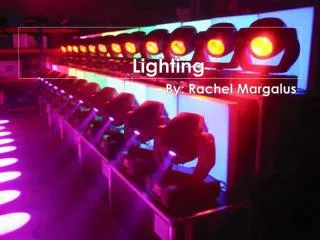
Lighting Instruments • Spotlights • Controlled beam / pinned & spread • Fresnel • Other spotlights • Ellipsoidal / leko / cutters / cookies • Barn doors / light pole / light stand
Lighting Instruments • Floodlights • Pans/broads --rectangular shaped • Scoop -- Bowl shaped • Strip lights for background • Softlight -- bulb points inward • Sometimes covered with scrim or gels
Three point lighting • Key --spotlight -- 35-40° angle • Fill -- flood or spread spot (1/2) • Back --spotlight (1.5-2x the key) • Subjects and foreground • Compare to background -- also important • Kicker --comes from the side over the camera left shoulder of the subject (added to 3-point lighting) • External lights must be eliminated / mixing light sources
Lighting effects • Silhouette--subject is not lit; background is evenly lit • Limbo--subject is lit evenly; background is vague or nondescriptive • Cameo--subject is lit with a spotlight directly above; background is not lit
Studio Lighting • Light Board / dimmers / pig tails • Grid vs. floor stand • Extension poles, c-clamp, safety • Inverse square law--as light to subject distance doubles, light level is reduced to 1/4 previous level ###