Ecosystem Needs Assessment for Camp Hantesa: Enhancing Recreation and Oak Regeneration
550 likes | 703 Vues
This assessment evaluates the current conditions at Camp Hantesa, a four-season recreational facility established in 1919, with a focus on wildlife habitat unit values, woodland quality, and recreation enhancements. The report outlines desired future conditions to improve passive and active recreation, increase native oak populations, and enhance habitat value through strategic management actions. The analysis incorporates systematic sampling, current recreational capacity, and economic evaluations, providing a framework for sustainable development and ecosystem management.


Ecosystem Needs Assessment for Camp Hantesa: Enhancing Recreation and Oak Regeneration
E N D
Presentation Transcript
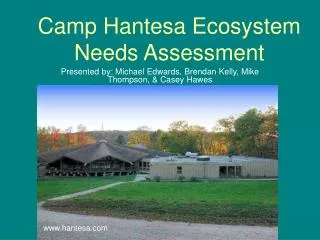
Camp Hantesa Ecosystem Needs Assessment Presented by: Michael Edwards, Brendan Kelly, Mike Thompson, & Casey Hawes www.hantesa.com
Jungst & Sons Consultants J & S Jungst
Outline • Intoduction • Current conditions • Desired future conditions • Management actions • Summary • Conclusion
General Information • Member of Campfire Association • Summer camp since 1919 • Four season recreational facility • 144 total acres • 100.4 forested acres
Topographic Map of Camp Hantesa www.terraserver.micrsoft.com
Purpose • Assess current: conditions wildlife habitat unit values (HUV), woodland quality (WQR), recreation, & oak regeneration. • Emphases: • 1) recreation • 2) enhancement of native oak
Goals & Objectives • Goals • Enhance native oak component • Increase passive and active recreation • Objectives • Increase basal area by 25% within 20 years • Improve recreation by 35% throughout forested area by 2025
Methods • Systematic sampling of 100.4 acres • 48 plots • Fixed radius • Point sampling • Assessment of factors critical to recreation, HUV, oak regeneration, & woodland quality.
Wildlife Habitat Unit Value (HUV) • Assessed for • 1) tree squirrels • 2) forest game (white-tailed deer and wild turkey) • Factors assessed: food, cover, water, reproduction, weather, & human disturbance. • Average 1) Tree Squirrels HUV=5.6 points 2) Forest game HUV=5.3 points
Habitat Unit Value (HUV) Source: Flood, Sangster, Sparrowe, Baskett 1977
Woodland Quality Rating (WQR) • Provides generalized idea of health for wooded area. • Primary factors: diversity, structure, fidelity, & introduced species.
WQR Scale • Average of 11.5 WQR points Source: Norris 1995
Tree Regeneration • No advanced oak regeneration found. • Large canopy prohibits understory growth.
Recreational Current Conditions • Area assessed for General Hiking, Primitive Camping, Wildlife Observation, & Horseback Riding. • Evaluation based on “Guidelines for Understanding and Determining Optimum Recreation Carrying Capacity (RCC)”. Source: (The Urban Research Development Corporation, 1977)
General Hiking • Average capacity 14.1 groups/mile
Primitive Camping • Average capacity of 27 Acres/campsite
Horseback Riding • Average capacity of 5.9 groups/mile
Wildlife Observation • Average capacity of 3.3 people/acre
Desired Future Conditions • Create areas of recreation throughout forested land having little/ no impact upon landscape. • Increase oak seedlings • Increase total oak population
Guiding Principles • Ecological: Humans inseparable from ecosystem. • Social: Human, physical, & biological ecosystem relationships are natural & intertwined. • Economic: Non-market & market goods based on human values. Source: (Kaufmann et. al. 1992; Salwasser & Pfister 1993; Task Force 1994)
Filtration Process All Possible Management Actions Guiding Principles Feasible Management Actions
Recreational Management Actions • Installation of recreational facilities based upon plots with highest recreational carrying capacity. • Three campsites • Wildlife observation area • General hiking trail • Horseback riding trail
Oak Management Actions Through Thinning • Removal of specified species • Thinning overstory opens canopy for seedlings • Removal of undesirable oaks (UGS) post regeneration
Continued • Removal of basswood, ash, iron wood, hard maple. • Opens canopy • Reduces competition • Increase of oak sprouting potential
Cost & Benefit of Thinning:Present Day • Cost • 2 Fellers at 4 hours/Acre • $40/hour • Benefit • $165/cord of firewood
Benefits Example Equation Thinning for basswood, ash, hardwood maple, & ironwood 1,100 cu ft/Acre/128 cu ft = 9 cords/Acre 9 cords/Acre x $165/cord= $1,500/Acre 100.4 Acres x $1,500/Acre= $150,600 total
Calculation of Cost of Thinning 2 Fellers x $40/hour x 4 hours/Acre = $320/Acre $320/Acre x 100.4 Acres= $32,000 total cost
Present Benefit/Cost Ratio $150,600 benefit / $32,000 cost= 4.70 Benefit/Cost Ratio For every dollar invested there will be a return of $4.70. Net revenue= $119,000
Cost of Recreation • Heavy chainsaw work • $40/ hour x 4 people= $160/ hour • $160/ hour x 80 hours= $12,800 total • Heavy hand cutting • $35/ hour x 4 people= $140/ hour • $140/ hour x 80 hours= $11,200 total • Total cost • $11,200 + $12,800= $24,000 total cost
Thinning Net Revenue & Recreation Costs • Thinning net revenue • $119,000 • Recreation Costs • $24,000 • $119,000 - $24,000= $95,000 total net revenue
Evaluation and Adaptation of Decisions • Observe changes every 5 years • Make adjustment in plan if necessary • Re-evaluate conditions after 20 year period
Emphases & Objectives • Emphases • Enhance native oak component • Increase passive and active recreation • Objectives • Increase basal area by 25% within 20 years • Improve recreation by 35% throughout forested area by 2025
Desired RCC Future Conditions • Create areas of recreation throughout the forested land that will have little to no impact upon the landscape.
Desired Oak Future Conditions • Increase oak seedlings • Increase total oak population
RCC Management Recommendations • Creation of recreational activities based upon plots with highest recreational carrying capacity • Three campsites • Wildlife observation area • General hiking trail • Horseback riding trail