Download
1 / 10
100 likes | 124 Vues
Gahir Law is a reputable law firm that handles a variety of Legal cases in different areas. Presently, they deal with Residential and commercial real estate, licence appeal tribunal law, Immigration laws, professional regulation disciplinary, commercial land development, Mediator arbitrator law, corporate law and appeal law. To protect your legal rights diligently, give us an opportunity to serve you. For more information - https://www.gahirlaw.com/past-cases/<br>

E N D
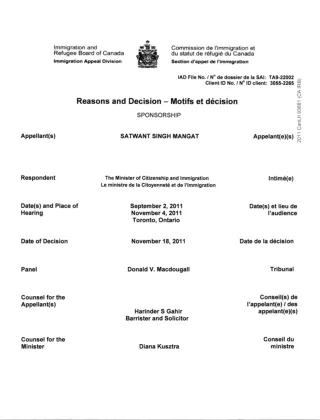
lmmig16lion and Refugee Board of Canada lmmhr.tlon Apgaal Olvi.lo.i Cornmission de l'immigration et du statut de r6fugi6 du Canada S.cllon dlppol da rlmmlgmtlon IAD File No. / No de dossiel de la SAI: Client lD No. / No lD client: TA9-22002 3055-2265 (nt o Reasons and Decision - Motifs et d6cision @ (o o) Jcoo SPONSORSHIP Appellant(s) Appelant(e)(s) SATWANT SINGH MANGAT N Respondent lntim6(e) The Minister of Citizenship and lmmigration Le ministre de la Citoyennet6 et de I'lmmigration Date(s) and Place of Hearing September 2, 2011 November 4, 20'll Toronto, Ontario Date(s) et lieu de l'audience Date of Decision November 18,2011 Date de la d6cision Tribunal Donald V. Macdougall Panel Conseil(s) de l'appelant(e) / des appelant(e)(s) Counsel for the Appellant(s) Harinder S Gahir Barrister and Solicitor Counsel for the Minister Conseil du m in istre Diana Kusztra
IAD File No. / N" de dossier de la SAI: TA9-22002 Client lD No. / No ID client: 3055-2265 REASONS FOR DECISION mt () lntroduction and lssue The appellant appeals pursuant to section 63(l) of the Immigration and Refugee tll Protection ,lc/ 1tnf,l) from a decision of the immigration officer not to issue a permanent resident visa to his applicant wife, on the basis that the marriage is not genuine and that it was @ (o (f) o) = )C(!o o N entered into primarily for the purpose of acquiring any status or privilege under the Act. tZ) The issue is whether the appellant has proven that the applicant is to be considered his spouse, and therefore a member of the family class, pursuant to Immigration and Refugee Protection Regulations2 ltnf g sections 117(l)(a) and 4. Decision t3] proven on a balance of probabilities that the marriage is genuine and that it was not entered into primarily for the purpose of acquiring any status or privilege under the Act. The appeal is Having considered the evidence and submissions, the panel finds that the appellant has allowed pursuant to section 66(a) of IRPA. Background t4l a perrnanent resident visa;a the appellant applied to sponsor the applicant as his spouse.t In In May 2008, the appellant and the applicant married in India.3 The applicant applied for I Immigration and Refugee Protection Act,5.C.2001, c.27. 2 Immigration and Refugee Protection Regulations, }OF.,2002-227, as amended. I Pxhibit R-1, pp. 10, 4l-45. o lbid., pp. l0-16,26-31. 5 Ibid., pp. 32-39.
IAD File No. / No de dossier de la SAI: TA9-22002 CIient lD No. / No lD client: 3055-2265 2 October 2009, the immigration officer refused that application for permanent residence, deciding that the applicant was excluded from being considered a spouse under IRPA.6 The appellant filed an appeal of that decision.T mt t5l At the hearing of this appeal the appellant testified and filed four Exhibits of documentary evidence; the applicant testified by teleconference from India. The respondent filed two Exhibits, including the Record. At the end of the hearing, the panel reserved its C) o (o cr) o) JEoo o N decision. 16] The 4l-year-old appellant was born in India, came to Canada in August 1994 and permanent resident. He was married to his first wife from 2002 until their divorce in 2008.8 married the applicant in May 2008. e He works as a truck driver. isa He 17) The 4l-year-old applicant was born in and is a citizen of India.r0 She was not married before marrying the appellant in May 2008.rr Analysis t8] A Canadian citizen or perrnanent resident may sponsor the application of a foreign national as a member of the family class; a spouse is a member of the family class.l2 However, if the marriage was entered into in bad faith,/RPR section 4 excludes that spouse from the family class: 4. Bad faith - (1) For the purposes of these Regulations, a foreign national shall not be considered a spouse, a common-law partner or 6 pxhiblt R-1, pp. 5-8. 7 Ibid., pp. t-2. t Ibid., pp. 35,40. 'lbid., pp. 10,41-45. 'o Exhibit R-1, p. lo. t' Ibid., pp. lo, 4l-45. " IRPR subsections 130(l), I17(1Xa).
IAD File No. / No de dossier de Ia SAI: TA9-22002 Client !D No. / No lD client: 3055-2265 3 a conjugal partner of a person if the marriage, common-law partnership or conjugal partnership (a) was entered into primarily for the purpose of acquiring any status or privilege under the Act; or c0 x. o (D) is not genuine. @ @ (O o, In considering whether the marriage is genuine for the purposes of IRPR, the panel t9] examined a number of factorsl3 and took into account additional evidence that was not before the JCo O o N immigration officer.la The panel is cognisant of the immigration objectives, especially "to see that families are reunited in Canada."l5 [0] on a balance of probabilities that the marriage is genuine and that it was not entered into primarily for the purpose of acquiring any status or privilege under IRPA. Although /RPR The appellant bears the burden of proof. To allow this appeal, the panel must be satisfied section 4 was amended,16 the findings in this case would have resulted in allowing the appeal under either test. lll] number of concerns, including that she and the appellant were not compatible in terms of age, The immigration officer interviewed the applicant in October 200917 and identified a education and marital background; the circumstances of the appellant's previous marriage were suspicious; the marriage was hastily arranged and the applicant was vague about the circumstances; the appellant was casually dressed at one point in the marriage ceremonies; there was minimal evidence of contact between the appellant and applicant; and that the applicant was not credible about a number of topics and inconsistent with the application documents. ll21 The panel considers that the immigration officer had reasonable concerns and suspicions after the applicant's interview. However, the evidence at the hearing provided reasonable " Kherav.M.C.L,2OO7FC632(FC) andChavez, Rodrigov.M.C.l. (lADTA3-24409),Hoare,February 11,2005 to Kahlonv. M.E.l. (19S9),7lmm. L.R. (2d) 9l (F.C.A.). " IRPA, section 3(lXd) t6 Immigration and Refugee Protection Regulations,SOP.,2002-227, as amended by PC20l-l176. '7 Exhibit R-1, pp.2o-25
IAD File No. / No de dossier de la SA!: TA9-22002 Glient lD No. / No lD client: 3055-2265 explanations for those concerns. d]g o Genuineness of marriage and development of the relationship @ (o (f) O) [3] India; his claim was rejected in December 1995, and judicial review was denied in January 1996. In 1996 and in February 2000, he made applications to remain in Canada on humanitarian and The appellant testified that he entered Canada in August 1994 as a refugee claimant from Jco (J o N compassionate grounds; although the details are unclear, it appears that those applications were dismissed or not continued. He testified that in January,200l, he met his first wife in Canada and they married in Canada in February 2002. He obtained permanent resident status in March 2005, and then separated from his first wife in May 2005, and they divorced in April 2008.18 [4] 2005 to attend his ill father, his wife did not want to go with him, and when he returned to He explained that he separated from his first wife because he went to India in March Canada his wife had moved out. He learned that she was living with a boyfriend she had before her marriage. The appellant also said that part of their differences was that he wanted to have children but she "was not ready." He testified that he delayed divorce because he wanted to reconcile, although he also agreed that he viewed it as intolerable that she was living with another man. Although the respondent submitted that these circumstances were suspicious and indicative of a marriage of convenience in order for the appellant to gain permanent residence status, the panel does not find that they are connected to or affect his second marriage or its genuineness, and finds that they have little weight in this appeal. [5] his second wife; his brother had known the applicant's father for about four to five years. The The appellanttestified that his brother, a police offrcer in India, arranged a meeting with applicant testified that the families had begun to consider a possible marriage about lYz months before they met; the appellant's brother had arranged photograph exchanges and the appellant had spoken briefly on the telephone with the applicant. They first met on May 3, 2008 at the '8 Exhibit R-1, pp. 9,33,35,40.
IAD File No. / No de dossier de la SAI: TA9-22002 S Client ID No. / No lD client: 3055-2265 appellant's brother's house in India, together with both sets of parents and other family members, and shared family and personal information. Both the appellant and applicant provided detailed, similar testimony about this meeting. The appellant and applicant both said they specifically (n E, shared information about the appellant's refugee claim in Canada, his first marriage, her decision to delay marriage, the difference in their formal education, and the (disabled) condition of the C) @ (o CO O) Jco (J applicant's brother; they both were satisfied that those factors did not negatively affect their decision to marry and that they found each other suitable. The applicant testified that the final decision to marry was made the next day. The panel finds that the timing of the appellant's O N divorce and the dates on the divorce documents are not significant when weighed against the other evidence about the relationship and its genuineness.'' These issues were concerns for the immigration officer but the panel finds that they were adequately explored and explained at this appeal hearing. [6] friends and family from both sides.2O Both the immigration officer and respondent's counsel The appellant and applicant married on May 19,2008, attended by a large number of submitted that the appellant's decision to change from formal pants into jeans at one point in the proceedings showed the appellant's casual approach to the marriage and was a negative factor in determining its genuineness; the panel does not agree. There are sufficient photographs showing the appellant in "formal" pant dress during the more formal part of the ceremony, some of the other attendees wore "casual" trousers, the appellant and applicant both explained this issue in their testimony, and from other visits the appellant made, he appears to be a devotee to wearing jeans.2l llTl The appellant stayed in India with his wife until mid-July 2008.22 re See Exhibit R-1, pp.40, 50. 'o Exhibit R-1, pp. lO,4l-45,76-81; Exhibit A-1, especially pp. 18, 3,7-9,12-13. 2'ExhibitA-1, pp. l-2,6-ll,12-13,14-15, l8-19,26and29;Exhibit A-2,pp.3-24. " Exhibit R-1, p. 50; Exhibit A-1,pp.44-45.
tAD File No. / No de dossier de la SAI: TA9-22002 Client ID No. / No lD client: 3055-2265 6 Post-marriage relationshi p [18] The appellant returned to India to be with his wife from mid-July through the end of August 2OlO.23 He visited his wife again forthree months from February through June 20ll.2a The appellant and applicant both described normal marital activities during those times, mg C) @ (o (t) o) including visits with relatives and to religious sites. The photographs submitted illustrate that they appear comfortable together. JCoo o N tlgl The appellant and applicant also testified that they communicate regularly by telephone.25 t20] The appellant and applicant have been involved in medical fertility treatments, attempting to have a child.26 They both testified about these ongoing efforts, which have resulted in two conceptions that have not terminated. They testified that their doctor has assured them that full- term pregnancy is likely. Additionally, the applicant described that during the appellant's 201I visit they arranged a three-day non-stop prayer function at his parent's home, involving many relatives and village members, in an effort to obtain blessings for childbirth. They both testified that if they fail to have a child, they are considering adoption. l2ll The panel finds that the application forms filed by the appellant and applicant presented some appropriate concerns for the respondent. Most important, there is an indication that the applicant was three-months pregnant, which both denied in their testimony.2' The applicant told the immigration officer at her interview that this was incorrect; the appellant testified that this was an error made by the agent who completed the forms, and referred to the medical information they fi led.28 2r Exhibit A-2, pp. 2-25, 45-51. 'o Exhibit A-2, pp. 27 -42, 45-51. 2s Exhibits A-2,pp.88-l l4; Exhibit R-1, pp. 52-73. 'u Ibid., pp. 53-87. 2'Exhibit R-1, p. 39. 28 The appellant also agreed that some of the information in Exhibit R-1, pp. 36-39 was incorrect.
lAD File No. / No de dossier de la SAI: TA9-22002 Client lD No. / No lD client: 3055-2265 7 122] Another puzzling aspect of the information filed was the discrepancy about ages and identities, especially on the "ration card", which the panel finds was sufficiently explained in the testimony.2n Additionally, the applicant's use of her parents' address on some of the d]t documentation, although the testimony indicated that she has lived "most of the time"30 with the C) appellant's parents, was adequately explained.3l @ (o (f) O) 123) The panel had the benefit of hearing and seeing the appellant testifr under affirmation and hearing the applicant testifr under affirmation. There is a presumption of truth in sworn Jc (o O o N evidence, unless there is reason to doubt that truthfulness.32 There was no inconsistency or implausibility that overcame the presumption of truth from the sworn evidence in this case. The panel finds that the appellant was sincere and accepts his evidence as being credible, trustworthy and reliable. The panel also is satisfied that the applicant's testimony was credible and trustworthy. l24l At this hearing, both the appellant and the applicant were questioned about the development of their relationship and asked about the related insufficiencies and issues identified by the immigration officers at the applicant's interview. The two mature witnesses testified in detail about each other's lifestyle and personal details and addressed reasonably the interviewer's concerns. Although some of the details were puzzling and on their face caused concern, the panel finds that they were plausibly and reasonably described and that nothing about them deters from the genuineness of the relationship that developed. The panel does not find that the evidence was manufactured to defeat the immigration process but finds that both the appellant and the applicant gave adequate and convincing explanations and that all of the evidence demonstrated a real and genuine relationship. " Exhibit R-2; Exhibit A-3; Exhibit A-4. ro Appellant's testimony. " Exhibit R-1, pp. 10, 85-86; Exhibit A-2, p. 103. 32 Maldonado v M.E.l., [980] 2 F.C. 302 (C.A.), at 305.
tAD Fite No. / No de dossier de la SA!: TA9-22002 Client lD No. / No lD client: 3055-2265 g Primary purpose of acquiring status under IRPA 125) The IRPR section 4 test applies to both sides of the marriage. The importance of membership in the family class by marriage is that the applicant is largely exempted from other requirements. The advantage sought in spousal appeals is generally entry to Canada and the d]g o @ (o (e O) JC (u C) granting of permanent resident status to the applicant as a member of the family class. Whether the relationship was entered into primarily for the purpose of acquiring any status or privilege under IRPAis usually self-evident and self-explanatory. o N 126) The applicant has never worked and the marriage may be seen to have economic advantages for her. Although the respondent posited that the applicant's purpose for the marriage might be to sponsor her father and brother to Canada, there was no evidence to support that and both the appellant and applicant denied it. I27) The genuineness of the marriage also presents strong evidence that the marriage was not entered into for the purpose of gaining immigration status. [28] The panel concludes that the evidence demonstrates that the acquisition of status under IRPA was not a primary purpose for the marriage of the applicant and appellant. Conclusion 129) The appellant has met his evidentiary and persuasive burden. Although, as submitted by the respondent, there could be some negative inferences from the evidence, the appellant has provided suffrcient evidence conceming the genuineness and purpose of his marriage. The panel finds that the evidence demonstrates on a balance of probabilities that there is a shared relationship of some perrnanence, that there is interdependence between the husband and wife, that there are shared responsibilities and that there is a serious commitment.3s 33 Jin: M.C.l. v. Jin, Keun(F.C., no. IMM-1604-08),Zinn,October 16, 2008, 2008 FC ll72 atparagraph 14.
tAD Fite No. / No de dossier de la SA!: TA9-22002 Client tD No. / No ID client: 3055-2265 9 t30] Having considered the factors and submissions and weighed the evidence, the panel finds that the appellant has proven on a balance of probabilities that the marriage is genuine and that it was not entered into primarily to acquire any status or privilege under IRPA. The appeal is d] x. o allowed pursuant to section 66(a) of IRPA. @ (o c.) O) JCo O o N NOTICE OF DECISION The appeal is allowed. The officer's decision to refuse a perrnanent resident visa is set aside, and the officer must continue to process the application in accordance with the reasons of the Immigration Appeal Division. "Donald V. Macdouqall" Donald V. Macdougall November 18,201'1 Date Judicial Review - Under section 72 of the Immigration and Refugee Protection Act, you may make an application to the Federal Court for judicial review of this decision, with leave of that Court. You may wish to get advice from counsel as soon as possible, since there are time limits for this application.