Understanding Photosynthesis: The Process of Energy Conversion in Plants
110 likes | 229 Vues
Photosynthesis is the vital process by which plants convert carbon dioxide, water, and light energy into glucose and oxygen. This occurs primarily in chloroplasts, organelles rich in chlorophyll, which captures light energy. The process consists of two main stages: Light-Dependent Reactions, which take place in the thylakoid membranes and generate ATP using sunlight, and Light-Independent Reactions that occur in the stroma, where glucose is synthesized. This mechanism not only sustains plant life but also supports the entire ecosystem by producing oxygen.


Understanding Photosynthesis: The Process of Energy Conversion in Plants
E N D
Presentation Transcript
Photosynthesis COS-2 ST.- 3, 14,16
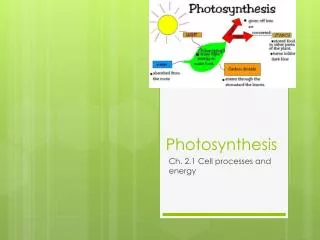
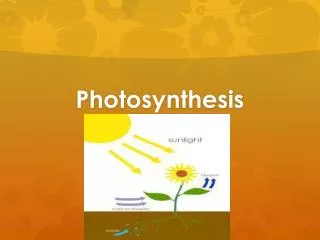
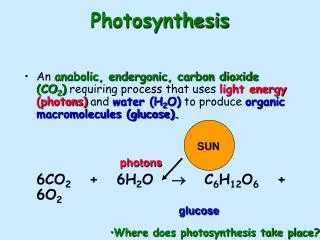
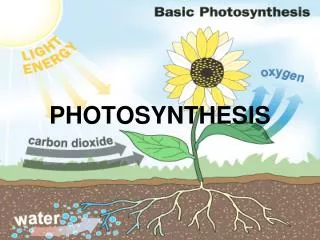
Photosynthesis • The process of converting CARBON DIOXIDE, WATER, and LIGHT ENERGY into OXYGEN and SUGAR MOLECULES. 6CO2 + 6H2O + light C6H12O6 (glucose) + 6O2
Photosynthesis • Takes place inside a cell organelle… Chloroplast • The chloroplast is part of the group or organelles called PLASTID • PLASTIDS- engage in photosynthesis and store the resulting food.
Chloroplast • Specific organelle with a double membrane • Contains stacks of sac-like membranes called thylakoids. • Thylakoid membrane contains a green pigment called chlorophyll • Pigments are substances that absorb light.
2 basic stages of photosynthesis • Light-Dependent Reactions • Take place inside thylakoid membrane • Light-Independent Reactions • Take place in the stroma (region just outside thylakoid membrane)
Light Dependent Reactions • Sunlight hits leaf of plant • Absorbed by pigments (Chlorophyll) • Light hits chlorophyll – electrons absorb energy become excited and leave the chlorophyll molecule • Carrier Molecules transport the electrons through electron chain transport chain • Electron acceptor molecules pick up electrons in a series and pass them from one molecule to another. • Energy is released and ATP is formed
Light-Independent Reaction • Occurs in the stroma • Forms glucose