Download
1 / 13
130 likes | 236 Vues
This report examines the socio-economic conditions in Russia before WWI from the Tsar’s perspective. It considers the advantages and disadvantages the Tsar faced in entering the Great War, including support for Slav nationalism and the fear of Austria-Hungary. The report will assess how the war impacted the Russian government, focusing on the economy—highlighting issues such as inflation, food supply shortages, and military challenges faced by Russian troops. Group analyses of primary sources will aid in understanding public sentiment toward the Tsar and the legitimacy of wartime narratives.

E N D
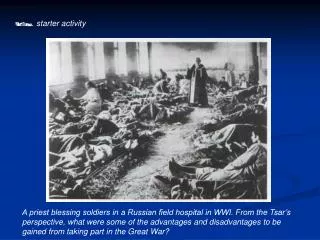
starter activity A priest blessing soldiers in a Russian field hospital in WWI. From the Tsar’s perspective, what were some of the advantages and disadvantages to be gained from taking part in the Great War?
What impact did WWI have on the government? Aims To assess the level of support for the Tsar on the eve of WWI To examine the impact of the War on the govt
Your task • Imagine you have been asked to compile report on the state of the nation on the eve of WWI (1914). • First read sources 19 and 20 on p. 76 (Oxley) and discuss how the views differ. • Work in small groups. Your teacher will give you an evidence collection sheet. Divide up among your group who will investigate each area in the given time. Come together as a group, share your knowledge and produce a report on socio-economic conditions in Russia on the eve of WWI. Which of the sources do you agree with most? Use pages 64-77 (Oxley)
Your task • Read Lynch p.60-1 and list the reasons why Russia entered the War.
Member of Triple Entente (with Fr. & GB) • Support for Slav nationalism in Balkans • Fear of over-powerful Austria-Hungary • Mobilisation of its army provoked Germany into declaring war Kaiser Wilhelm II Tsar Nicholas II
Your task • Examine the impact of the war on these areas of the economy:
Inflation • 17,000 m. roubles spent on War (1914-17) • Increased tax, loans, borrowing from abroad • Gold standard abandoned • Average earnings doubled, while price of food & fuel quadrupled Russian troops, WWI
Food supplies • Manpower diverted to war effort – 15m men taken from countryside • By 1917 36.7m men conscripted in army • Requisitioning of farm horses & supplies, e.g. chemicals for fertilisers used to make ammunition • Grain hoarding • Army 1st in queue for food supplies (at expense of towns & cities)
Transport • Strain on supply chain • Integrated network caused delays across the country if lines were blocked • Archangel, supplies sank into ground due to build-up • Trucks tipped down embankments to make way for others • Moscow, wagons of food declined from 2,200 (1914) to 700 (1917)
Army • 4,000,000 troops killed or wounded (1914) • Lack of ammunition, uniforms & equipment • Shipment of resources poorly organised • Desertions • Nicholas II assumed leadership of army • Possibility of ‘Bolshevik fabrication’ (Norman Stone)
Plenary • Do you agree with Norman Stone that the state of Russia’s army during WWI was just a ‘Bolshevik fabrication’? • Write a judgement paragraph explaining your answer.