Chandra Science Highlight
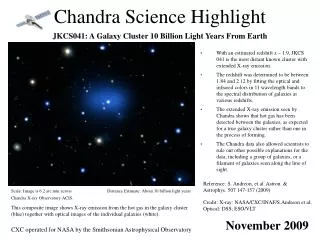
JKCS 041, located approximately 10 billion light years from Earth, is the most distant known galaxy cluster, confirmed by a redshift measurement of z~1.9. This groundbreaking discovery, presented in a Chandra X-ray Observatory study, reveals extended X-ray emission, indicating the presence of hot gas between galaxies—an essential feature of genuine galaxy clusters. By analyzing optical and infrared data across 11 wavelengths, scientists have definitively ruled out alternative explanations, establishing JKCS 041 as a true cosmic structure rather than a mere galactic formation.

Chandra Science Highlight
E N D
Presentation Transcript
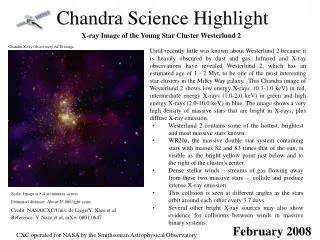
Chandra Science Highlight JKCS041: A Galaxy Cluster 10 Billion Light Years From Earth • With an estimated redshift z ~ 1.9, JKCS 041 is the most distant known cluster with extended X-ray emission. • The redshift was determined to be between 1.84 and 2.12 by fitting the optical and infrared colors in 11 wavelength bands to the spectral distribution of galaxies at various redshifts. • The extended X-ray emission seen by Chandra shows that hot gas has been detected between the galaxies, as expected for a true galaxy cluster rather than one in the process of forming. • The Chandra data also allowed scientists to rule out other possible explanations for the data, including a group of galaxies, or a filament of galaxies seen along the line of sight. Reference: S. Andreon, et al. Astron. & Astrophys. 507 147-157 (2009) Scale: Image is 6.2 arc min across Distance Estimate: About 10 billion light years Chandra X-ray Observatory ACIS. Credit: X-ray: NASA/CXC/INAF/S.Andreon et al; Optical: DSS; ESO/VLT This composite image shows X-ray emission from the hot gas in the galaxy cluster (blue) together with optical images of the individual galaxies (white). November 2009 CXC operated for NASA by the Smithsonian Astrophysical Observatory