Download
1 / 8
80 likes | 227 Vues
This article explores the remarkable ability of American Shad (Alosa sapidissima) to detect ultrasound frequencies, highlighting significant findings from Mann, Lu, and Popper's 1997 study. It delves into the anatomical mechanisms underlying sound detection, particularly the role of the swim bladder and inner ear structures. Through classical conditioning methods, fish learned to associate high-frequency sounds with electric shocks, allowing researchers to measure sensitivity thresholds across various frequencies. Observed behavioral responses suggest adaptive changes when exposed to ultrasonic stimuli, enhancing understanding of sensory capabilities in clupeid fishes.

E N D
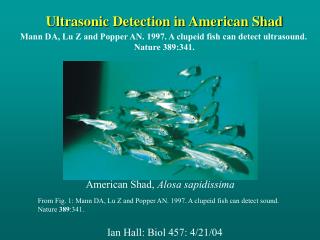
Ultrasonic Detection in American Shad Mann DA, Lu Z and Popper AN. 1997. A clupeid fish can detect ultrasound. Nature 389:341. American Shad,Alosa sapidissima From Fig. 1: Mann DA, Lu Z and Popper AN. 1997. A clupeid fish can detect sound. Nature 389:341. Ian Hall: Biol 457: 4/21/04
Clupeid Ear Function and Signal Transduction Sound = Pressure Change Pressure change around the fish causes volume change in swim bladder Swim Bladder is connected to Bulla Volume change in the Bulla pulls on the Elastic Thread The Elastic Thread transduces signal to the inner ear organs Inner Ear Organs: Lagena, Saccule, and Utricle (anterior, posterior and middle)
Methods: Classical Conditioning A stimulus (high frequency sound) is immediately followed by an electric shock. Fish learn to anticipate the shock by the presence of the sound stimulus. The conditioned behavior is the reduction of heart rate From Fig. 2: Mann DA, Lu Z and Popper AN. 1997. A clupeid fish can detect ultrasound. Nature 389:341.
Results: Thresholds for Various Frequencies Threshold Decrease = Increased Sensitivity Two sensitive regions: 0.2-0.8 kHz and 25-130 kHz From Fig. 2: Mann DA, Lu Z and Popper AN. 1997. A clupeid fish can detect ultrasound. Nature 389:341.
Swimming behavior changes in response to ultrasonic stimulation - A maximal behavior response is seen when fish are stimulated with sound at 90 Hz. From Fig. 1 : Plachta DA, Popper AN. 2003. Evasive responses of American shad (Alosa sapidissima) to ultrasonic stimuli. Acoustics Research Letters Online 4(2): April 2003.
Does the High Frequency Sensitivity correlate with Cetacean Echolocation? Spotted Dolphin calls range from ~40-130 kHz From Fig. 5 Au WWL, Herzing DL, 2003, Echolocation signals of wild Atlantic spotted dolphin (Stenella frontalis) ,The Journal of the Acoustical Society of America 113:598–604
Why can some clupeids detect ultrasound and others can’t? The middle macula (mm) is loosely connected to the rest of the utricle in fish that can detect ultrasound… American Shad Gulf Menhaden Bay Anchovy Scaled Sardine …and firmly attached in animals that cannot. From Fig 6 Higgs DM, Plachta DTT, Rollo AK, Singheiser M, Hastings MC, and Popper AN. 2004. Development of ultrasound detection in American shad (Alosa sapidissima) The Journal of Experimental Biology 207: 155-163.
References Au WWL, Herzing DL, 2003, Echolocation signals of wild Atlantic spotted dolphin (Stenella frontalis) ,The Journal of the Acoustical Society of America 113:598–604. Higgs DM, Plachta DTT, Rollo AK, Singheiser M, Hastings MC, and Popper AN. 2004. Development of ultrasound detection in American shad (Alosa sapidissima) The Journal of Experimental Biology 207: 155-163. Mann DA, Lu Z and Popper AN. 1997. A clupeid fish can detect ultrasound. Nature 389:341. Plachta DA, Popper AN. 2003. Evasive responses of American shad (Alosa sapidissima) to ultrasonic stimuli. Acoustics Research Letters Online 4(2): April 2003.