Understanding One-Dimensional Motion: Position-Time and Velocity-Time Graphs
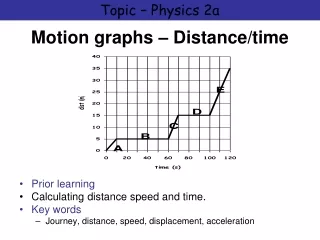
This guide explores one-dimensional motion using position-time and velocity-time graphs. Positive and constant velocity, as well as changing velocity due to acceleration, are depicted with constant slopes. The section explains how the slope of a velocity-time graph indicates acceleration, with formulas for calculating displacement via rectangular, triangular, and trapezoidal areas under the curve. It clarifies the difference between distance (scalar) and displacement (vector), providing practical examples and calculations for each.

Understanding One-Dimensional Motion: Position-Time and Velocity-Time Graphs
E N D
Presentation Transcript
Motion Graphs 1 Dimensional Motion
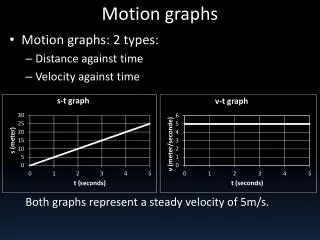
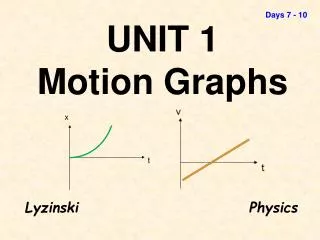
Position-time graph • The object in motion would have positive and constant velocity
Position-time graph • The object in motion would have a positive but changing velocity (acceleration)
Both graphs depict an object with constant and negative slope • The object on the right as a greater velocity
Negative acceleration • Object is moving in the negative direction and is speeding up
Velocity-Time Graph • the slope of the line on a velocity versus time graph is equal to the acceleration of the object
Slope if a velocity-time graph • Since the slope of a velocity-time graph determines the object acceleration, the objects acceleration is calculated with the following equation:
Slope of velocity-time graph • Example
Distance vs. Displacement • Distance is a scalar quantity which refers to "how much ground an object has covered" during its motion. (12m)
Distance vs. Displacement • Displacement is a vector quantity which refers to "how far out of place an object is"; it is the object's overall change in position. (0m)
Finding the displacement • The shaded area is representative of the displacement during from 0 seconds to 6 seconds. This area takes on the shape of a rectangle can be calculated using the appropriate equation.
Finding the displacement • Area of a rectangle A= b x h A= (6s) x (30m/s) A = 180m
Finding the displacement • The shaded area is representative of the displacement during from 0 seconds to 4 seconds. This area takes on the shape of a triangle can be calculated using the appropriate equation.
Finding the displacement • Area of a triangle A = ½ x b x h A = (½) x (4s) x (40m/s) A = 80 m
Finding the displacement • The shaded area is representative of the displacement during from 2 seconds to 5 seconds. This area takes on the shape of a trapezoid can be calculated using the appropriate equation.
Finding the displacement • Area of a Trapezoid A = (½) x (b) x ( h1 + h2) A = (½ )x (2s) x (10m/s +30m/s) A = 40 m