SlideServe
Menu
Préférences
© SlideServe · v2026

Atomic History & Atomic Structure!

matana avatar
24 diapositives · 1.3K Views · Oct 11, 2014

Atomic History & Atomic Structure!. Notebook Add-ons: P. 22: Unit 1 Test P. 23: “Unit 2 Key Terms” P. 24: “Unit 2 Proficiency Tracker” P. 25: “Atomic Theory Timeline” Chart P. 26: Periodic Table P. 27: Title: “Notes: Atomic Structure P. 28: “Atomic Structure Chart” Homework!
Atomic History & Atomic Structure! - slide 1
01 / 24Atomic History & Atomic Structure!
1 / 17

Télécharger la présentation

Atomic History & Atomic Structure!
Une image / un lien ci-dessous est fourni (tel quel) pour télécharger la présentation

Politique de téléchargement : le contenu du site vous est fourni TEL QUEL pour votre information et votre usage personnel ; il ne peut être vendu, concédé sous licence ni partagé sur d’autres sites sans l’accord de son auteur.Le contenu vous est fourni TEL QUEL, pour votre information et votre usage personnel uniquement. Téléchargez la présentation en cliquant sur ce lien. Lors du téléchargement, si vous ne parvenez pas à télécharger une présentation, l’éditeur a peut-être supprimé le fichier de son serveur.Pendant le téléchargement, si vous ne parvenez pas à obtenir une présentation, le fichier a peut-être été supprimé par l’éditeur.

F I N

Plus de contenu associé

Transcription de la présentation
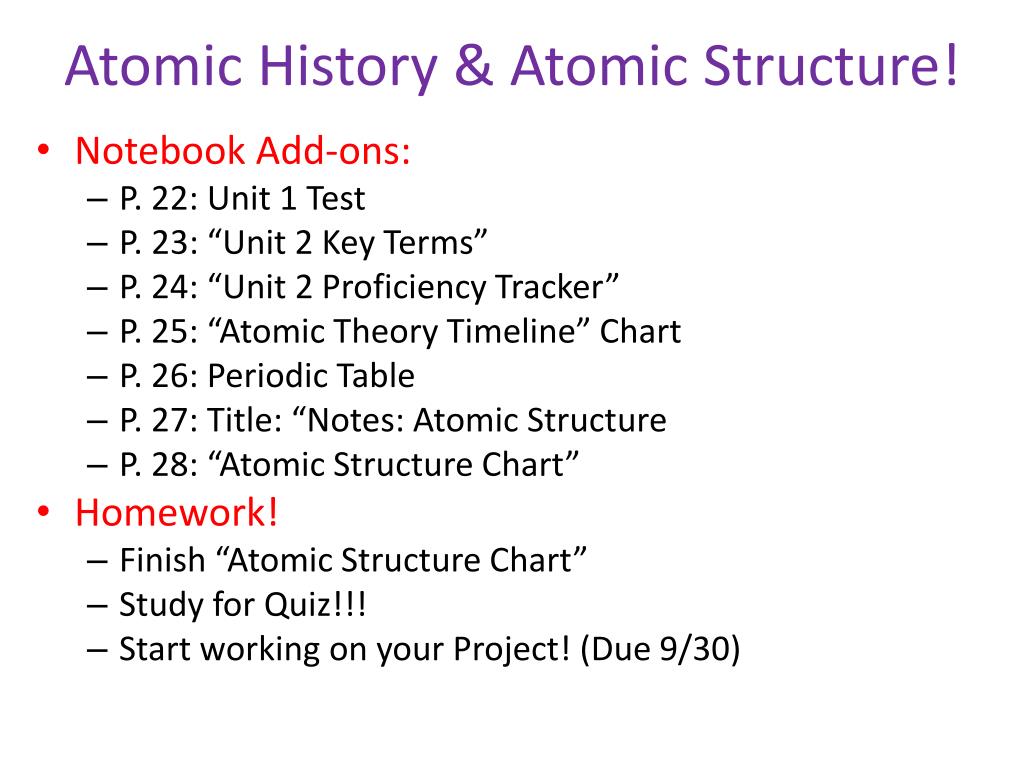
  1. Atomic History & Atomic Structure! • Notebook Add-ons: • P. 22: Unit 1 Test • P. 23: “Unit 2 Key Terms” • P. 24: “Unit 2 Proficiency Tracker” • P. 25: “Atomic Theory Timeline” Chart • P. 26: Periodic Table • P. 27: Title: “Notes: Atomic Structure • P. 28: “Atomic Structure Chart” • Homework! • Finish “Atomic Structure Chart” • Study for Quiz!!! • Start working on your Project! (Due 9/30)

  2. Mystery Box • With your table group… try to figure out what is inside the “Mystery Box” • DON’T OPEN IT!!!!  • How small is an atom??? • http://www.youtube.com/watch?v=aQnbF-zpDiM

  3. Atomic Theory • Discuss with your table groups your research findings on your scientist.

  4. Atomic Theory Timeline Fill in your chart!

  5. John Dalton (1803)

  6. Dalton’s Postulates • All elements are composed of tiny indivisible particles called atoms. • Atoms of the same element are identical. The atoms of any one element are different from those of any other elements. • Atoms of different elements can physically mix together or can chemically combine with one another in simple whole-number ratios to form compounds. • Chemical reactions occur when atoms are separated, joined, or rearranged. Atoms of one element, however, are never changed into atoms of another element as a result of a chemical reaction.

  7. Dalton’s Postulates • We now know that certain parts of this theory are invalid. • Part 1 – False. Atoms have been split. • Part 2 – Partially False. Some atoms of the same element have more neutrons. (However, atoms of different elements are different.) • Part 3 – True! • Part 4 – True!

  8. Dalton’s Model • Just a tiny ball with no parts inside

  9. J. J. Thomson (1897)

  10. J. J. Thomson • Used a cathode ray tube to shoot an electrical charge through it. • Saw that the particles were deflected towards the positive end of the tube. • This must mean that atoms contained a NEGATIVE charge! • Discovered the ELECTRON. http://www.youtube.com/watch?v=IdTxGJjA4Jw http://www.youtube.com/watch?v=RW_zfKOU9uM

  11. Thomson’s Model • “Plum Pudding” or “Chocolate Chip Cookie Dough” Model. • A ball of positive charge containing a number of electrons.

  12. Ernest Rutherford (1911)

  13. Ernest Rutherford • Did the Gold Foil Experiment • Shot alpha (positively charged) particles at a sheet of gold foil. • Saw that most particles passed through the foil and some deflected straight back at different angles. • Means that atoms are mostly empty space but contain a densely packed positive center…. • Discovered the NUCLEUS http://www.youtube.com/watch?v=wzALbzTdnc8&NR=1 http://www.youtube.com/watch?v=5pZj0u_XMbc

  14. Rutherford Model Dense, positively charged nucleus Surrounded by electrons (mostly empty space) Empty Space Nucleus Electrons

  15. Niels Bohr (1913)

  16. Niels Bohr • Electrons travel in definite orbits around the nucleus • Electrons are found in “energy levels” • AKA Planetary Model http://www.youtube.com/watch?v=wCCz20JOXXk

  17. Bohr Model Nucleus Electrons (orbiting the nucleus)

  18. Atomic Structure p. 27

  19. Proton Neutron Electron

  20. Element Info on the Periodic Table Atomic Number (#protons) Element Symbol Element Name Atomic Mass

  21. Other Info • Mass Number = #p + #n • NOT the same as Atomic Mass… you CAN’T find this on the P.T.! • # of electrons: • If #of electrons is the same as the # of protons --- NEUTRAL ATOM • If the # of electrons is NOT the same as the # of protons --- ION

  22. Beans activity • A Carbon atom has: • 6 protons • 6 neutrons • 8 electrons • Create a “bean atom” of carbon.

  23. Atomic Symbols Mass Number (#protons + #neutrons) Charge (#protons - #electrons) 6C 12 2- Atomic Number (#protons)