Download
1 / 9
100 likes | 228 Vues
In the summer of 2012, archaeologists from Leicester University excavated the site of Greyfriars church, focusing on the choir area known for important burials. They uncovered a skeleton exhibiting a curved spine, suggesting the individual had a notable physical deformity, with one shoulder appearing higher than the other. The remains showed signs of multiple wounds, including a significant skull injury. DNA testing confirmed the identity of the skeleton as Richard III, whose burial site had been lost for nearly 500 years, raising questions about his life and legacy.

E N D
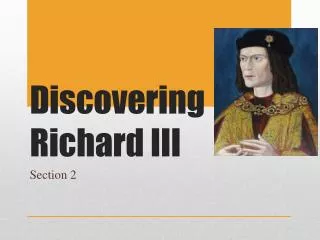
Discovering Richard III Section 2
Archaeologists at Work • In summer 2012 archaeologists from Leicester University excavated the site of Greyfriars church. • They looked at the choir area where important burials took place.
Finding a Skeleton • They found a skeleton with a curved spine.
Finding a Skeleton • The curve of the spine would have made this man look as if one shoulder was higher than the other.
Finding a Skeleton • The skeleton had suffered a number of wounds including a heavy blow to the back of the skull from a sharp blade …..
Finding a Skeleton • … like the poll-axe or halberd this knight is holding.
Testing DNA • DNA tests were carried out using • teeth and a leg bone from the skeleton • and DNA from a descendant of Richard III’s sister
The DNA Tests Reveal … It is Richard III His body has been identified after being lost for nearly 500 years. but …