Exploring Synthetic Pore-Forming Dendritic Dipeptides for Diverse Biological Functions
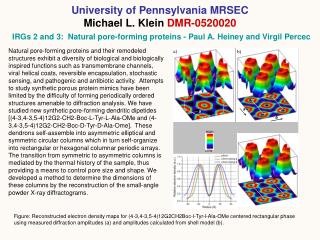
This study investigates synthetic pore-forming dendritic dipeptides (specifically (4-3,4-3,5-4)12G2-CH2-Boc-L-Tyr-L-Ala-OMe and (4-3,4-3,5-4)12G2-CH2-Boc-D-Tyr-D-Ala-Ome), focusing on their self-assembly into structured columns. These dipeptides can form either symmetric or asymmetric columns that organize into periodic arrays. The transition between structures is influenced by thermal history, allowing control over pore size and shape. A novel method was developed to assess the dimensions of these columns using reconstructed small-angle powder X-ray diffractograms.

Exploring Synthetic Pore-Forming Dendritic Dipeptides for Diverse Biological Functions
E N D
Presentation Transcript
a) b) a a b HIGH LOW University of Pennsylvania MRSECMichael L. Klein DMR-0520020IRGs 2 and 3: Natural pore-forming proteins - Paul A. Heiney and Virgil Percec Natural pore-forming proteins and their remodeled structures exhibit a diversity of biological and biologically inspired functions such as transmembrane channels, viral helical coats, reversible encapsulation, stochastic sensing, and pathogenic and antibiotic activity. Attempts to study synthetic porous protein mimics have been limited by the difficulty of forming periodically ordered structures amenable to diffraction analysis. We have studied new synthetic pore-forming dendritic dipetides [(4-3,4-3,5-4)12G2-CH2-Boc-L-Tyr-L-Ala-OMe and (4-3,4-3,5-4)12G2-CH2-Boc-D-Tyr-D-Ala-Ome]. These dendrons self-assemble into asymmetric elliptical and symmetric circular columns which in turn self-organize into rectangular or hexagonal columnar periodic arrays. The transition from symmetric to asymmetric columns is mediated by the thermal history of the sample, thus providing a means to control pore size and shape. We developed a method to determine the dimensions of these columns by the reconstruction of the small-angle powder X-ray diffractograms. Figure: Reconstructed electron density maps for (4-3,4-3,5-4)12G2CH2Boc-l-Tyr-l-Ala-OMe centered rectangular phase using measured diffraction amplitudes (a) and amplitudes calculated from shell model (b).