The Science of Clouds: Formation, Types, and Precipitation Explained
Learn how clouds are formed by understanding the three essential elements: water vapor, condensation nuclei (like dust, smoke, and salt), and changes in pressure. Explore why different types of clouds exist based on varying wind conditions, temperature, and humidity. Discover the general shapes of clouds, including cumulus (puffy), stratus (layered), and cirrus (whispy ice crystals). Also, delve into precipitation types associated with these clouds, focusing on how drop size affects whether it will rain.

The Science of Clouds: Formation, Types, and Precipitation Explained
E N D
Presentation Transcript
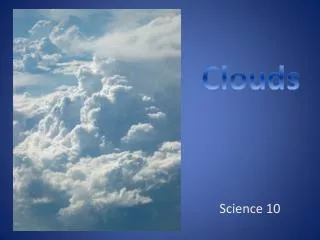
Clouds Science 10
How are clouds formed? • 3 things are needed to make a cloud • Water vapour • Condensation Nuclei – small particles for water to condense on • Dust, smoke, pollen and sea salt • Change in pressure
Why different types of clouds? • If all clouds formed from water, why are there different types? • The Conditions • Wind conditions • Temperature • Humidity
3 General Shapes • Cumulus – puffy clouds with flat bases • “Cauliflower clouds”
3 General Shapes • Stratus – seemingly endless layers • Very flat clouds • Tend to make the day dark and dreary • Fog = low lying stratus cloud
3 General Shapes • Cirrus – made of ice crystals instead of water droplets • Happen when little water vapour is in the air • “Mare Tales” clouds (whispy looking)
Precipitation • Stratus or cumulus clouds can have precipitation • Combine name with a form of nimbus or nimbo • Stratus = nimbostratus • Cumulus = cumulonimbus
Low Clouds • Under 2000m • Nearly all are stratus (although also above 2000m)
Middle Clouds • Between 2000m and 6000m • Prefix “alto-” used
High Clouds • Over 6000m • Since almost always made of ice crystals, their names are starting with “cirro” or ending with “cirrus”
All Level Clouds • Some cumulus clouds have a low base and go up way past 6000m.
Will it Rain? • Determined by drop size • Average is 0.2mm • A drop must be 0.5mm to fall (fine mist) • Most drops average 2mm