Galaxy formation with warm dark matter
250 likes | 388 Vues
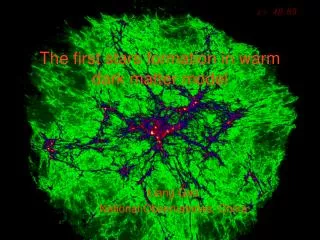
This presentation explores the impact of Warm Dark Matter (WDM) on galaxy formation, focusing on subhalo structure and the reionization process. Key insights include how WDM alters particle mass, supressing low-mass substructures and delaying reionization compared to Cold Dark Matter (CDM). The Neutrino Minimal Standard Model (nMSM) offers a theoretical framework for understanding neutrino masses and their potential as dark matter candidates. Simulations reveal the relationship between dark matter properties and galaxy characteristics, shedding light on cosmic evolution and structure formation.


Galaxy formation with warm dark matter
E N D
Presentation Transcript
Galaxy formation with warm dark matter Mark Lovell Adrian Jenkins, Carlos Frenk, Vince Eke, Tom Theuns, Liang Gao, Shi Shao, Simon White, Alexey Boyarsky, Oleg Ruchayskiy… Ripples in the Cosmos 22/07/2013
Outline • WDM reminder (see Carlos’ talk) • How does subhalo structure change with WDM particle mass? • Effect of WDM on reionisation?
nMSM • Neutrino Minimal Standard Model (nMSM) conceived to explain neutrino masses (Asaka & Shaposhnikov, 2005). • Adds three sterile neutrinos to the SM. The lightest of these would be a dark matter candidate. • Large velocities at early times => WDM / CWDM U C T g D S B g e m t W ne nm nt Z H N1 N2 N3
WDM • Phase space limit (small cores ~pc) • Free-streaming • Low mass substructures suppressed. • Later formation times • Concentrations lower • Reionisation delayed Lovell et al. 2012
Simulation Suite – Vital Statistics • 5 resimulations of the Aquarius Aq-A halo: 4WDM models + CDM, WMAP7 cosmology • Dark matter simulation particle mass 1.5x10⁴Msun • WDM particle masses mp=1.4keV, 1.6keV, 2.0keV, 2.3keV (thermal relics) • PWDM/PCDM = (1+(ak)n)-10/n [n=1] • a=a[mp]
PWDM/PCDM = (1+(ak)n)-10/n [n=1] (Bode et al. 2001) m1.4 m1.6 m2.0 m2.3 CDM Lovell et al. (in prep.)
Msub - Vmax Lovell et al. (in prep.)
Vmax – rmax[concentration] WMAP7 WMAP1 Lovell et al. (in prep.)
NFW vsEinasto Lovell et al. (in prep.)
Density Profiles (1) Lovell et al. (in prep.)
Density Profiles (2) Lovell et al. (in prep.)
Central Densities # Too Big to Fail: CDM: 6 m2.3: 4 m2.0: 3 m1.6: 3 m1.4: 1 Field Haloes Subhaloes No Problem for WDM
Simulations No feedback Feedback enabled • Aq-A4 halo • SPH – Gadget3 code • CDM/WDM vs. Supernova feedback/no feedback • Salpeter IMF • Multiphase ISM • Primordial cooling tables • Decoupled winds (Springel&Hernquist 2003) CN CW CDM WN WW WDM (1.4keV)
Reionising the (Local) Universe… Preliminary Warning!! Uber-simple model!
Conclusions • Exciting WDM / CWDM models motivated by nMSM • Subhalo structure • Vmaxes, central densities lower with progressively warmer models at a given mass – alleviates ‘too big too fail’ problem. Cosmology also plays a role. • Reionisation • WDM models produce enough photons to reionise each hydrogen atom, subgrid model important.
Mass functions Lovell et al. (in prep.)
Since you asked… Lovell et al. (in prep.)
… S S Lovell et al. (in prep)