Understanding Structural Loading and Components in Building Construction
This guide explores the fundamental concepts of structural loading and the three main types of stress: tension, compression, and shear. It examines the substructure of buildings, which includes all components below ground level, highlighting its significance to overall integrity. Additionally, the document distinguishes between primary elements, essential for support and enclosure, and secondary elements, which provide specific functions like completing openings. This foundational knowledge is crucial for anyone studying or working in construction and architecture.

Understanding Structural Loading and Components in Building Construction
E N D
Presentation Transcript
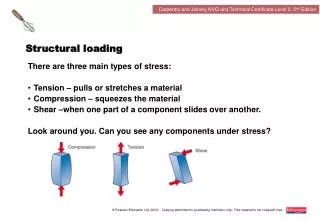
Structural loading • There are three main types of stress: • Tension – pulls or stretches a material • Compression – squeezes the material • Shear –when one part of a component slides over another. • Look around you. Can you see any components under stress?
Substructure All buildings have a substructure – all of the structure below ground, up to and including the damp proof course. What is the main part of a substructure?
Superstructure: primary elements Primary elements are the main supporting, enclosing and protecting elements of the superstructure. They divide space and provide floor-to-floor access. What primary elements can you name?
Superstructure: secondary elements The secondary elements are not essential to the building’s strength or structure, but provide a particular function, such as completing openings in walls. What secondary elements can you name?