Understanding Chemical Reactions: Elements, Compounds, and Reaction Types
This educational material provides a comprehensive overview of elements and compounds, along with the five basic types of chemical reactions: synthesis, decomposition, single replacement, double replacement, and combustion. It includes detailed definitions, examples of each reaction type, and common patterns observed in the reactions. Students will learn to identify substances as elements or compounds and classify various chemical reactions, reinforcing their understanding of the foundational concepts in chemistry.

Understanding Chemical Reactions: Elements, Compounds, and Reaction Types
E N D
Presentation Transcript
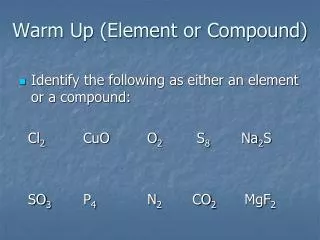
Warm Up (Element or Compound) • Identify the following as either an element or a compound: Cl2CuO O2 S8 Na2S SO3 P4 N2CO2 MgF2
REMINDER! • Element: a substance that contains only one type of atom • Compound: a substance that is composed of atoms of different elements • NOW RE-CHECK YOUR ANSWERS
Warm Up (Element or Compound) • Identify the following as either an element or a compound: Cl2CuO O2 S8 Na2S SO3 P4 N2CO2 MgF2
Chemical Reactions Thousands of reactions But we are only concerned with The “Basic 5 Types”
What is happening in common for all of the following reactions? • 2 Na + Cl2 → 2 NaCl • N2 + 3 H2 → 2 NH3 • 2 Mg + O2 → 2 MgO • C + O2 → CO2 • P4 + 6 Cl2 → 4 PCl3
Synthesis Two or more simpler substances come together to form a new substance A + B AB
Synthesis • Always makes one product out of multiple reactants. +
Synthesis When magnesium is burned in the presence of oxygen gas, magnesiumoxide is formed. Magnesium + oxygen magnesiumoxide 2Mg + O2 2MgO
What is happening in common for all of the following reactions? • 2 HgO → 2 Hg + O2 • 2 H2O → 2 H2 + O2 • 2 NaCl → 2 Na + Cl2 • CaCO3 → CaO + CO2 • H2SO4 → H2O + SO3
Decomposition A compound breaks down into two or more simpler substances AB A + B
Decomposition • Always takes one reactant and breaks apart into simpler materials. + + + +
Sodium iodide Water+oxygen Hydrogen peroxide Decomposition When hydrogen peroxide is in the presence of sodium iodide, it breaks down into water and oxygen gas. (electrolysis of water) 2H2O2 2H2O + O2
What is happening in common for all of the following reactions? • Fe + CuSO4 → FeSO4 + Cu • Cl2 + 2 NaBr → 2 NaCl + Br2 • Zn + 2 HCl → ZnCl2 + H2 • Mg + H2O → MgO + H2
Single replacement One element replaces another element in a compound AB + C CB + A
Single Replacement • A single element replaces a positive or negative ion in a compound.
Single Replacement When copper reacts with silvernitrate, silver and coppernitrate are produced. Copper + silvernitrate silver+coppernitrate Cu + AgNO3 CuNO3 + Ag ?? Activity series ??
What is happening in common for all of the following reactions? • NaCl + AgNO3 → NaNO3 + AgCl • BaCl2 + Na2 SO4 → 2 NaCl + BaSO4 • 2 HCl + FeS → FeCl2 + H2S • HCl + NaOH → NaCl + H2O
Two ionic compounds in aqueous solution “switch partners” to form at least one new solid, liquid, or gas. Double replacement AB + CD AD + CB
Double Replacement • The positive ions in two compounds switch places in a reaction & make two new compounds. Positive ions
Double Replacement When lead nitrate reacts with potassiumiodide, potassiumnitrate and leadiodide are produced. Lead(II)nitrate + potassiumiodide potassiumnitrate+lead(II)iodide Pb(NO3)2 + 2KI 2KNO3 + PbI2
What is happening in common for all of the following reactions? • CH4 + 2 O2 → CO2 + 2 H2O • 2 C4H10 + 13 O2 → 8 CO2 + 10 H2O • C6H12O6 + 6 O2 → 6 CO2 + 6 H2O • 2 C8H18 + 25 O2 → 16 CO2 + 18 H2O • C2H5OH + 3 O2 → 2 CO2 + 3 H2O
Combustion Compounds (typically with hydrogen and carbon) are combined with oxygen which then produces carbon dioxide and water CxHy + O2 CO2 + H20
Combustion • A compound of carbon and hydrogen reacts with oxygen gas and produces carbon dioxide and water ALWAYS!! + +
Combustion When ethanol reacts with oxygengas, water and carbon dioxide are produced. ethanol + oxygen water + carbon dioxide C2H5OH + 3O2 3H2O + 2CO2
YouTube Experiment • Culligan Bottle Experiment • Better View
Identify the type of reaction:BaCl2 + Na2 SO4 → 2 NaCl + BaSO4 • Synthesis • Decomposition • Single Replacement • Double Replacement • Combustion
Identify the type of reaction:N2 + 3 H2 → 2 NH3 • Synthesis • Decomposition • Single Replacement • Double Replacement • Combustion
Identify the type of reaction:CaCO3 → CaO + CO2 • Synthesis • Decomposition • Single Replacement • Double Replacement • Combustion
Identify the type of reaction:CH4 + 2 O2 → CO2 + 2 H2O • Synthesis • Decomposition • Single Replacement • Double Replacement • Combustion
Identify the type of reaction:Zn + 2 HCl → ZnCl2 + H2 • Synthesis • Decomposition • Single Replacement • Double Replacement • Combustion
Identify the type of reaction:C6H12O6 + 6O2 → 6CO2 + 6H2O • Synthesis • Decomposition • Single Replacement • Double Replacement • Combustion