Understanding Reaction Types and Predicting Products in Chemistry
This guide offers a comprehensive overview of determining the type of chemical reactions, predicting products, and utilizing the activity series for both metals and halogens. It covers essential concepts such as double displacement reactions, solubility rules, and the identification of precipitates. Learn to break down reactants into ions, apply charges, and write balanced molecular and net ionic equations effectively. This practical resource is ideal for students seeking to enhance their chemical reaction prediction skills and deepen their understanding of fundamental chemistry principles.

Understanding Reaction Types and Predicting Products in Chemistry
E N D
Presentation Transcript
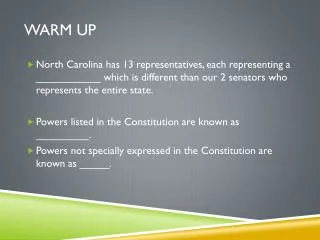
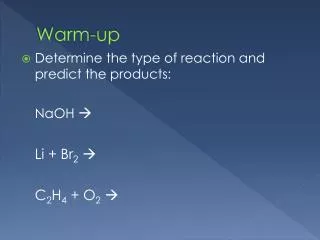
Warm-up • Determine the type of reaction and predict the products: NaOH Li + Br2 C2H4 + O2
Activity Series • How to use the activity series. • Find the element in the compound on the table. • Find the Solo element • If the solo element is above the element in the compound then the reaction will take place.
2Al(s) + 3ZnCl2(aq) To replace the Zinc, Aluminum must be higher on the series Cu(s) + 2NaCl(aq) Can copper replace sodium in the compound? 3Zn(s) + 2AlCl3(aq) NO REACTION
Activity Series for Halogens • Above the activity series for metals, there is an activity series for Halogens. • If your solo element is a halogen, it will replace the bonded halogen as long as it is above it on the activity series. • Remember, every halogen on the series is a diatomic molecule, so when it’s by itself, there will be two of them (F2, Br2, …)
Practice! Cr(NO3)2(aq) + Pb(s) • Cr(s) + Pb(NO3)2(aq) • Pt(s) + CaCl2(aq) • Ca(s) + FeO(aq) NO REACTION CaO(aq) + Fe(s)
Warm-up • Determine the type of reaction and predict the products: NaOH Li + Br2 C2H4 + O2
Predicting Products:Double Displacement Unit 6, Day 5 Kimrey 1 November
Remember Double Displacement • Anions switch places and are each bonded to a different cation • AB + CD AD + CB
Predicting the Products of Double Displacement • Involves determining charges, criss-crossing, and the solubility rules
Why do solubility rules matter? • All double displacement reactions (in this unit) will produce a precipitate • A precipitate is a solid that’s produced during a chemical reaction in a solution • So, if a precipitate is not formed, then the reaction will not take place!! • We can determine if a precipitate is formed by looking at our solubility rules
Solubility • If something is soluble, then it can be dissolved by what it’s bonded to • If something is insoluble, then it cannot be dissolved
What does it mean for us? • If one of your products is insoluble, then its state of matter is solid and a precipitate has formed. • If one of your products is soluble, then its state of matter is aqueous and no precipitate has formed. • You must have at least one solid product for a reaction to occur.
Solubility Rules: Soluble • Soluble • All Nitrates, Acetates, Ammoniums, and Group 1 salts. • All Chlorides, Bromides, and Iodides, except Silver, Lead, and Mercury (I) • All Fluorides except Group 2, Lead (II), and Iron (III) • All Sulfates except Calcium, Strontium, Barium, Mercury, Lead(II), and Silver
Solubility: Insoluble • Insoluble • All Carbonates and Phosphates except Group 1 and Ammonium • All Hydroxides except Group 1, Strontium, Barium , and Ammonium • All Sulfides except Group 1, Group 2, and Ammonium • All Oxides except Group 1
Steps • First break the reactants into their ions (find the charges!). • Next, swap partners for both (OI with a twist) • Check solubility rules to see if a solid (precipitate) has formed. • Write complete balanced equation with states of matter.
Example • Sodium Hydroxide + Copper (II) Sulfate • What are the Ions? • What are the reactants? • What are the potential products? • Are any potential products insoluble? • What is the complete equation
PracticePredict the products and determine if a precipitate forms. • Sodium phosphate + Nickel (II) chloride • NaCl and Ni3(PO4)2. • Lead (II) Nitrate + Potassium Iodide • PbI2 and KNO3 • Sodium Hydroxide + Potassium Chloride • NaCl and KOH • Sodium phosphate + Lead (IV) nitrate • Pb3(PO4)4and NaNO3
Writing molecular equations • You already know how to do this! • This is the chemical equation with the states of matter in it. • Make sure it’s balanced!
Writing the Net Ionic equation • You almost know how to do this! • Start with the completely balanced equation. • Look at the solid product and make it the product of your Net Ionic equation. • For the reactants, put the ions that lead to the product
Example • Na2SO4 + CaCl2 2NaCl+ CaSO4 • SO42-(aq)+ Ca2+(aq)CaSO4 (s) • 3NaOH + FeCl3 3NaCl + Fe(OH)3 • 3OH-(aq) + Fe3+(aq) Fe(OH)3 (s)
Net Ionic equation • Take the complete ionic equation and remove the spectator ions. • Spectator ions are the ions not involved in the reaction. • Ex. Na2SO4 + CaCl2 2NaCl+ CaSO4 • CaSO4 (s)+ 2NaCl(aq) • SO42-(aq)+ Ca2+(aq) CaSO4 (s)
Practice • NaCl + AgNO3 AgCl +NaNO3 • Na+(aq) + Cl-(aq) + Ag+(aq) + NO3-(aq)AgCl(s) + Na+(aq) + NO3-(aq) • Ag+(aq) + Cl-(aq)AgCl(s) • 2NaOH + CuSO4 Cu(OH)2 + Na2SO4 • 2Na+(aq) + 2OH-(aq)+ Cu2+(aq)+ SO42-(aq) Cu(OH)2(s) + 2Na+(aq)+ SO42-(aq) • Cu2+(aq)+ 2OH-(aq) Cu(OH)2 (s)