
Combating Dissipation
E N D
Presentation Transcript
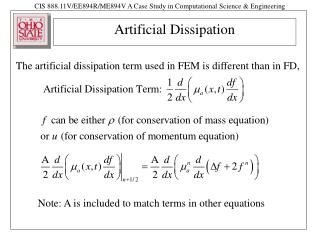
Numerical Dissipation • There are several sources of numerical dissipation in these simulation methods • Error in advection step • Pressure projection (time splitting) • Not addressed yet in graphics! • Level set redistancing • Focus on the first
Dissipation Example (1) • Start with a function nicely sampled on a grid:
Dissipation Example (2) • The function moves to the left(perfect advection) and is resampled
Dissipation Example (3) • And now we interpolate from new sample values, and ruin it all!
The Symptoms • For velocity: • Too viscous or sticky (molasses), or at an implausible length scale (scale model) • Turbulent detail quickly blurred away • For smoke concentration: • Smoke diffuses into thin air too fast,nice sharp profiles or thin features vanish • For level sets: • Water evaporates into thin air, bubbles disappear
High Order/Resolution Schemes • That said, we can do a lot better thanfirst-order semi-Lagrangian • High order methods: use more data points to get more accurate interpolation • Cancel out more terms in Taylor series • Problem: inevitably can give undershoot/overshoot (too aggressive) • Stability for nonlinear problems? • High resolution methods: high order except near sharp regions
Sharpening semi-Lagrangian • Can also do better with semi-Lagrangian approach • Sharper interpolation- e.g. limited Catmull-Rom [Fedkiw et al ‘02] • Estimating error and subtracting it • BFECC [e.g. Kim et al ‘05] • Using derivative information • CIP [e.g. Yabe et al. ‘01]
Example • Exact (particles) vs. 1st order vs. BFECC
Aside: resampling • Closely related to the sampling theorem:frequencies above a certain limit cannot be reliably recovered on a grid • Sharp features have infinitely high frequency! • Schemes which use an Eulerian grid as fundamental structure are inherently limited(forced to use higher resolution than is strictly necessary)
Particle-in-Cell Methods • Back to Harlow, 1950’s, compressible flow • Abbreviated “PIC” • Idea: • Particles handle advection trivially • Grids handle interactions efficiently • Put the two together:- transfer quantities to grid- solve on grid (interaction forces)- transfer back to particles- move particles (advection)
PIC • Start with particles • Transfer to grid • Resolve forces on grid • Gravity, boundaries, pressure, etc. • Transfer velocity back to particles • Advect: move particles • Start with particles • Transfer to grid • Resolve forces on grid • Gravity, boundaries, pressure, etc. • Transfer velocity back to particles • Advect: move particles
PIC • Start with particles • Transfer to grid • Resolve forces on grid • Gravity, boundaries, pressure, etc. • Transfer velocity back to particles • Advect: move particles • Start with particles • Transfer to grid • Resolve forces on grid • Gravity, boundaries, pressure, etc. • Transfer velocity back to particles • Advect: move particles
PIC • Start with particles • Transfer to grid • Resolve forces on grid • Gravity, boundaries, pressure, etc. • Transfer velocity back to particles • Advect: move particles
PIC • Start with particles • Transfer to grid • Resolve forces on grid • Gravity, boundaries, pressure, etc. • Transfer velocity back to particles • Advect: move particles
PIC • Start with particles • Transfer to grid • Resolve forces on grid • Gravity, boundaries, pressure, etc. • Transfer velocity back to particles • Advect: move particles
FLuid-Implicit-Particle (FLIP) • Problem with PIC: we resample (average) twice • Even more numerical dissipation than pure Eulerian methods! • FLuid-Implicit-Particle (FLIP) [Brackbill & Ruppel ‘86]: • Transfer back the change of a quantity from grid to particles, not the quantity itself • Each delta only averaged once: no accumulating dissipation! • Nearly eliminated numerical dissipation from compressible flow simulation… • Incompressible FLIP [Zhu&Bridson’05]
Where’s the Catch? • Accuracy: • When we average from particles to grid, simple weighted averages is only first order • Not good enough for level sets • Noise: • Typically use 8 particles per grid cell for decent sampling • Thus more degrees of freedom in particles then grid • The grid simulation can’t see/respond to small-scale particle variations – can potentially grow in time • Regularize: e.g. 95% FLIP, 5% PICCan actually determine ratio which matches a particular physical viscosity!