Download
1 / 9
90 likes | 206 Vues
The Digital Town Square (DTS) serves as a platform for large-scale, community-based health promotion initiatives aimed at addressing chronic diseases by tackling social determinants of health. This model fosters collaboration across various sectors, providing sustainable strategies through active community participation. By digitizing health interventions and creating a hub for data sharing, the DTS enables the effective integration of health services, urban planning, and evidence-based resources. It aims to improve local relevance and accessibility, facilitating better-informed health decisions and outcomes.

E N D
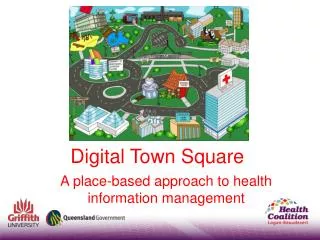
Digital Town Square A place-based approach to health information management
The Goal • PBI = Large-scale community-based health promotion initiative focused at a local level (e.g. USA Healthy Cities Project, ‘Promise Neighbourhoods’; UK Health Action Zones). • Logan Beaudesert PBI to alleviate chronic disease burden via addressing complex social determinants of health • Support integration and collaboration across multiple sectors within communities • Sustainable strategies focused on participation, partnerships & integrated actions at local level
Concept: Digital Town Square • Online infrastructure for data sharing and evidence-based resources: • Policy at local and state level; • Health service & urban planning; • Models of health care delivery and place based health promotion. • Online community: • Sustainable learning, planning and support networks; • Place based e-health promotion; • Integrated planning.
The Research • Pilot implementation of DTS with one health promotion network – early years; • Digitises existing offline interventions; • Compares online & offline environments & outcomes; • Explores synergies between online & offline approaches to health promotion & service delivery.
The Modules • Core modules: • HDSS (web based GIS) • Predictive Modelling • Evidence Repository • Online Coaching • Digital Stories (lived experience of DOH) • Coalition Private Domain
The Benefits • Central point of contact/reference • Accesses rural/remote consumers • Sharing ‘siloed’ data across complex networks • Links consumers, practitioners & policy makers • Cost-effective digital interventions • Ready data collection opportunities • Local relevance of information & networks • Portable infrastructure
Key Questions for HIM • How can the local community readily provide input into health-related programs and services? • How can we foster collaboration across services? • How can we make better use of research and evidence-based resources? • How do we foster a holistic approach to health using information?