Micro-Penetrators for Icy Planets: Impact Trials and Future Missions
This study explores micro-penetrators designed for icy planets, emphasizing their ability to survive extreme impacts while performing scientific investigations beneath the surface. We successfully tested three 13kg aluminum penetrators, achieving a subsonic impact velocity of ~310 m/s at a 10-degree nose-up angle in dry sand. The penetrators reached depths of ~4m, withstanding forces up to 17kgee. Future missions will focus on deploying them on harder targets like ice and concrete, enhancing their operational capabilities and data transmission from within alien environments.

Micro-Penetrators for Icy Planets: Impact Trials and Future Missions
E N D
Presentation Transcript
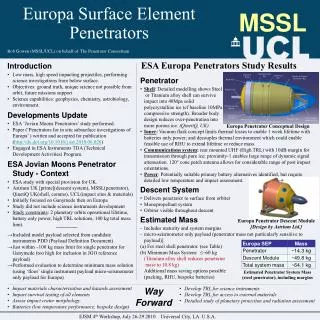
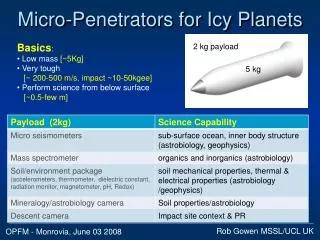
Micro-Penetrators for Icy Planets • Basics: • Low mass [~5Kg] • Very tough [~ 200-500 m/s, impact ~10-50kgee] • Perform science from below surface [~0.5-few m] 2 kg payload 5 kg
Impact Trial – May 19-21 2008 • Configuration: • 3 penetrators (~0.6m long, ~13kg, Aluminium • ~310 m/s impact velocity (just subsonic) • ~10 degs nose-up impact angle (worst case) • Dry sand target • Results: • All 3 penetrators survived (& 2 hit steel girder) • ~4m penetration depth • ~5-17kgee forces measured • Possibly 1’st micro-seismometer survival at 10Kgee. • Next steps: • Harder targets (ice, sand/ice, concrete) • Fully operational configuration • Transmission from target • Supporting studies