Download
1 / 35
350 likes | 475 Vues
This course focuses on the essential aspects of appearance models in computer graphics, emphasizing the interaction between materials, geometry, lighting, and rendering. It explores the evolution of rendering techniques from the 70s to the present, including physically-based materials and lighting models. Students will engage with advanced topics such as inverse rendering, image-based modeling, and real-time rendering methods, while also examining the importance of material recognition in both graphics and vision. Join us to delve into computational methods and current research in this area.

E N D
Appearance Models for Graphics COMS 6998-3, Lecture 1 Ravi Ramamoorthi
This course mainly focuses on materials • But appearance depends on geometry, materials, lights Computer Graphics Rendering Geometry Lighting Rendering Image Materials Viewpoint Camera
Geometry 70’s, 80’s: Splines 90’s: Range Data Rendering Algorithm 80’s,90’s: Physically based Materials/Lighting (Texture Reflectance[BRDF] Lighting) Realistic input models required Arnold Renderer: Marcos Fajardo Photorealistic Rendering
One Motivation: Digital Actors Final Fantasy Shrek
Computer Vision Analysis Image Lighting Vision alg. Geometry Materials Viewpoint Camera • Most algorithms assume very simple lighting, materials
Materials Inverse Rendering Lighting Geometry Inverse Rend Viewpoint Camera • Useful for acquiring material models in graphics • Recognizing materials in vision
Material Recognition Photographs of 4 spheres in 3 different lighting conditions courtesy Dror and Adelson
Complex materials • Geometry, illumination, reflectance all important • Often scales of geometry: Continuum of geometry/reflectance
Appearance important other areas • Physics • Materials science • Cosmetics • Building materials • Car paints • Textiles • Art Using computer, complex simulations doable
Topics • Modeling how light interacts with matter • Measurement/acquisition of materials • Image-based modeling and rendering • Analytic methods • Real-time rendering • Focus mainly on computational methods
Outline • Why appearance models? • Examples of recent graphics images • Approaches: Physical, structural, phenomenological methods • Overview of course logistics
Outdoor Scenes Deussen et al. 98
Weathering: Metallic Patinas Dorsey and Hanrahan 96
Weathering: Flows Dorsey and Hanrahan 96
3D Texture (CURET database) Dana et al 97
Diffraction Stam 99
Subsurface Scattering Jensen et al. 2001
Hair Marschner et al.
Approaches • Physical: Understand basic physics • Structural: Understand microstructure (patinas, fabrics, layered models) • Phenomenological: Empirical
Physical example: Fresnel • Dielectrics: Increasing specularities grazing angles • Metals: reflection changes with wavelength Copper-colored Cook-Torrance
(Micro)Structure CD Hair Fiber Plastic microfabric
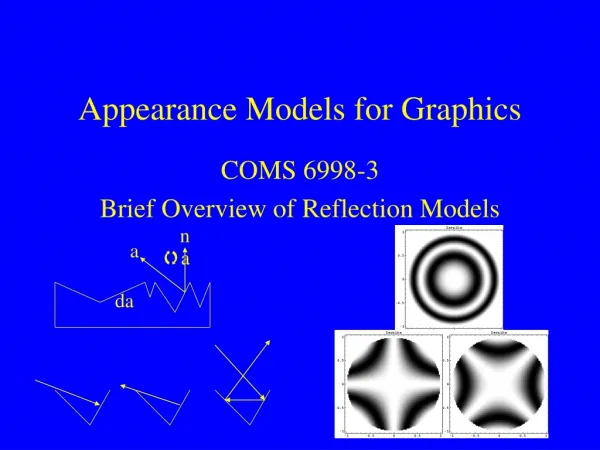
Phenomenological Models • Lambertian: • Phong: • Really corresponds to extended light source • Also, gaussian surfaces, splines, wavelets, Zernike polynomials, spherical harmonics, … • BRDF itself phenomenological model
Taxonomy of Materials Renderman World Plastic Metal Matte ShinyPlastic ThinPlastic RoughMetal
Real World? Real World Animal Vegetable Mineral Skin Hair Leaves Bark Marble
Course Goals, Format • Goal: Background and current research on appearance models in graphics and vision
Course Goals, Format • Goal: Background and current research on appearance models in graphics and vision • Columbia is the best place for this!!
Course Goals, Format • Goal: Background and current research on appearance models in graphics and vision • Columbia is the best place for this!! • Format: Alternate lectures, student presentations of papers • http://www.cs.columbia.edu/~ravir/6998/
Course Logistics • No textbooks. Required readings are papers available online (except 3 handouts today) • Office hours: before class. My contact info is on my webpage: http://www.cs.columbia.edu/~ravir • Will (almost certainly) count for PhD elective breadth in graphics/HCI (if taken on grades)
Requirements • Pass-Fail • Show up to class regularly • Present 1 (maybe 2) paper(s) • Prefer you do this rather than just sit in • Grades • Attend class, participate in discussions (10%) • Present 2 (maybe 3) papers (30%) • Project (60%)
Project • Wide flexibility if related to course (some ideas off main course webpage). Can be done in groups of 2-3 • Implementation/extension of one of the papers • Modeling of challenging natural object • Theoretical analysis/extension/verification • Best projects will go beyond simple implementation (try something new, some extensions) • Alternative (less desirable): Summary of 3 or more papers in an area • Best projects will explore links/framework not discussed by authors, and suggest future research directions
Prerequisites • Strong interest in graphics (and vision) • Computer graphics experience (4160) • What if lacking prerequisites? Next slide • Course will move quickly • Covering recent and current active research • Some material quite technical • Assume some basic knowledge • Many topics. Needn’t fully follow each one, but doing so will be most rewarding.
If in doubt/Lack prerequisites • Material is deep, not broad • May be able to pick up background quickly • Course requirements need you to really fully understand only one/two areas (topics) • But if completely lost, won’t be much fun • If in doubt, see if you can more or less follow some of papers after background reading • Ultimately, your call
Assignment this week • E-mail me (ravir@cs) • Name, e-mail, status (Senior, PhD etc.) • Will you be taking course grades or P/F • Background in graphics/any special comments • Optional: Papers you’d like to present FCFS • Paper presenters for next week [You (may) get a one-paper reduction in load] • Oren-Nayar, Torrance-Sparrow, Koenderink-van Doorn