Download
1 / 1
10 likes | 127 Vues
This session summarizes critical advancements in energy and luminosity spectrum diagnostics related to machine and particle physics. It focuses on the implementation of beam line diagnostics, such as upstream/downstream energy spectrometers, and highlights the importance of beam tests and specifications, including BPM requirements and energy spread design. Discussions extend to the need for E-z correlation diagnostics, realistic beam simulations, and the examination of Bhabha acolinearity. The session also explores the role of radiative returns and beam collision dynamics in enhancing physics results.

E N D
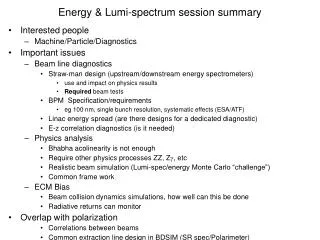
Energy & Lumi-spectrum session summary • Interested people • Machine/Particle/Diagnostics • Important issues • Beam line diagnostics • Straw-man design (upstream/downstream energy spectrometers) • use and impact on physics results • Required beam tests • BPM Specification/requirements • eg 100 nm, single bunch resolution, systematic effects (ESA/ATF) • Linac energy spread (are there designs for a dedicated diagnostic) • E-z correlation diagnostics (is it needed) • Physics analysis • Bhabha acolinearity is not enough • Require other physics processes ZZ, Z, etc • Realistic beam simulation (Lumi-spec/energy Monte Carlo “challenge”) • Common frame work • ECM Bias • Beam collision dynamics simulations, how well can this be done • Radiative returns can monitor • Overlap with polarization • Correlations between beams • Common extraction line design in BDSIM (SR spec/Polarimeter)