Understanding Energy Production: The Roles of Autotrophs and Heterotrophs in Cellular Respiration
This guide explores the processes of energy conversion in living organisms, highlighting the differences between autotrophs (producers) and heterotrophs (consumers). Key concepts include photosynthesis, cellular respiration, and the biochemical pathways leading to ATP production. It emphasizes the interconnection between these processes and their reliance on sunlight as the primary energy source. The journey from glucose to ATP involves glycolysis, the Krebs cycle, and the electron transport chain, showcasing how organisms harvest and utilize energy for life.

Understanding Energy Production: The Roles of Autotrophs and Heterotrophs in Cellular Respiration
E N D
Presentation Transcript
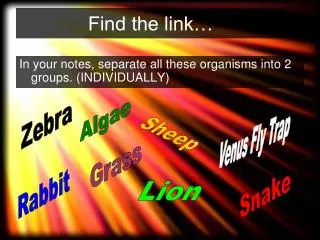
Find the link… In your notes, separate all these organisms into 2 groups. (INDIVIDUALLY) Algae Zebra Venus Fly Trap Sheep Grass Lion Rabbit Snake
Chapter 7 Energy From Food
Messy Chapter! • Lots of material • Important to read sections PRIOR to lesson
Sunlight Powers Life • Certain organisms convert energy from sun to chemical energy in food… • Some make food themselves • AUTOtrophs producers (photosynthesis) • Some rely on others for food • HETEROtrophs consumers ALWAYS starts with the sun!
Harvesting Energy in Food • Plants and other producers use light energy to make organic molecules • Cellular Respirationis the chemical process that uses oxygen to convert the chemical energy stored in organic molecules into another form of energy ATP(main energy supply)
Working Together • The products of photosynthesis are the chemical ingredients for cellular respiration • The products of cellular respiration are the chemical ingredients for photosynthesis
Types of Energy (NRG) • Kinetic anything moving • Potential stored energy • Chemical form of potential, depends on the structure of molecules • Organic molecules have high chemical NRG • Calorie amount of NRG needed to raise the temperature of 1g of water by one degree C • Kcal
ATP packs energy for cellular work • Chemical NRG stored in foods (organic molecules) must first be converted to ATP What is ATP? Pg 143 Structure Adenosine TRI-phosphate How is works “compressed spring” joins chemical reaction potential NRG is released (loose 1 P) ATP ADP (lost a P, adenosine DI-phosphate)
ATP Di • Adenosine Tri Phosphate • ATP ADP + P + energy • Energy released used in metabolic activity ENERGY P P P
ATP & Cellular Work • What ATP does • energy for dehydration synthesis for linked AA • contraction of muscle cells • crossing across cell membrane • Electron transport chain
ATP Cycle • ATP continuously converted to ADP as cells do work… but need cant use ADP… • Recycles! • Page 144
Cellular Respiration ATP • NRG in food used to make ATP(NRG for cellular work) • Cell Respiration happens in inner membrane of mitochondria • MANY STEPS!! Glycolysis Krebs CycleElectron Transport Chain 38 ATP total
ATP and Cell Respiration • Cell respiration main goal is to make ATP for cell work 6 Carbon Dioxide Glucose ATP 38 6 Water 6 Oxygen What you need to write… 1 Glucose 38 ATP
Cellular Respiration ATP • NRG in food used to make ATP(NRG for cellular work) • Cell Respiration happens in inner membrane of mitochondria • MANY STEPS!! Glycolysis Krebs Cycle Electron Transport Chain 38 ATP total
Mitochondrion! • Cell respiration happens in the mito • Structure of mito is KEY to its role in respiration • Envelope of 2 membranes • Thick fluid between inner and outer membrane (called the matrix) • Complex folding high surface area maximize ATP production
Stage 1: Glycolysis Pg 149 • Occurs outside the mitochondria • In the cytoplasm • What glycolysisneeds (input) • 2 ATP molecules, 1 Glucose Molecule, 2 NAD+ • What glycolysisproduces (output) • 2 NET ATP (4 total) • 2 Pyruvic acids • 2 NADH (each holds 2 electrons) TO ETC • 2 Water Molecules
Steps of Glycolysis • What happens • 1. 2 ATP splits glucose in half Yields 2 Carbon molecules each with a P group • 2. Each carbon molecule transfers electrons AND hydrogen ions to a carrier molecule (NAD+) • 3. NAD+ then turns into NADH with the addition of the 2 electrons and 1 hydrogen • 4. Through a chemical reaction a P is taken from the carbon molecule forms ATP (2 for every NADH) INVESTED 2 ATP YIELDED 4 ATP net gain 2ATP
P P P P P P ATP e e ADP NAD+ NADH ATP ATP ADP ADP ATP 3 Carbon 3 Carbon 3 Carbon 6 Carbon 2 Pyruvic Acids 3 Carbon 3 Carbon 3 Carbon ADP Glucose ATP e e NAD+ NADH ATP Both NADH move to the ETC Add 2 ATP REACTIONS OCCUR RESULT 4 ATP BUT!! 2 invested so NET gain is 2 ATP
Stage 2: The Krebs Cycle Pg 150 • Finishes the breakdown of pyruvic acid into carbon dioxide (releases more NRG) • Where this occurs matrix of mito • Input Acetyl CoA • 1 Pyruvic acid – CO2 = 1 Acetyl CoA(happens twice) • During this we make 2 NADH and 2 Water molecules • Output 4 CO2, 6 NADH, 2 ATP, 2 FADH2 the 6 NADH & 2 FADH2 go to the ETC
The Krebs Cycle • 1. Acetyl CoA joins acceptor molecule • Produces 2 CO2 • 2. Electron Carriers (NADH & FADH2) trap NRG • 3. One ATP, 3 NADH, 1 FADH2 & 2 CO2 is produced for every 1 Acetyl CoA • THEREFORE… • KREBS turns TWICE for every 1 Acetyl CoA (also for every glucose)
Stage 3: Electron Transport Chain (ETC) pg 151-152 • Where inner membrane of mito • Input NADH transfer electrons to ETC • Output 34 ATP • Joins with 2 ATP from glycolysis and 2 ATP from Krebs • 36-38 ATP total from 1 glucose molecule • Add 2 ATP to start reaction!
The ETC 2 steps : ETC and ATP Synthase • 1. ALL electron carriers carry electrons to ETC • 2. Move down “chain” being more strongly attracted as they move from protein to protein • 3. Oxygen is the FINAL ELECTRON ACCEPTOR, uses them to form water with hydrogen atoms • 4. AS electrons move, hydrogen atoms pumped across membrane from low to high concentration
ATP Synthase • NRG stored from ETC used in ATP synthase • 5. Rush downhill through this structure • 6. Uses NRG from H+ ions to convert ADP ATP • 7. Makes 34 ATP
H+ H+ H+ H+ H+ H+ H+ H+ H+ ALL H+ Pumped Down ETC of Glycolysis 2 NADH Run ATP Synthase Protein 3 Protein 1 Protein 4 P2 4 e- 4 e- 4 e- ½ O2 Makes Water 2 NADH 2 NAD+ H+ H+ H+ H+ 6 ATP Molecules H+ H+ H+ H+ H+ H+ H+ H+
H+ H+ H+ H+ H+ H+ H+ H+ H+ ALL H+ Pumped Down ETC of Pyruvate 2 NADH Run ATP Synthase Protein 3 Protein 1 Protein 4 P2 4 e- 4 e- 4 e- ½ O2 Makes Water 2 NADH 2 NAD+ H+ H+ H+ H+ 6 ATP Molecules H+ H+ H+ H+ H+ H+ H+ H+
H+ H+ H+ H+ H+ H+ H+ H+ H+ ALL H+ Pumped Down ETC of Krebs 6 NADH Run ATP Synthase Protein 3 Protein 1 Protein 4 P2 12 e- 12 e- 12 e- ½ O2 Makes Water 6 NADH 6 NAD+ H+ H+ H+ H+ H+ 18 ATP Molecules H+ H+ H+ H+ H+ H+ H+ H+ H+ H+ H+ H+ H+
H+ H+ H+ H+ H+ H+ H+ H+ H+ ETC of Krebs 2 FADH2 Run ATP Synthase Protein 3 Protein 1 Protein 4 4 e- P2 2 FAD+ 2 FADH2 4 ATP
ATP Synthase • 2 NADH from Glycolysis forms 12 H+ Ions, 6 ATP • 2 NADH from Pyruvate forms 12 H +Ions, 6 ATP • 6 NADH from Krebs 36 H+ ions, 18 ATP • 2 FADH2 from Krebs 4 ATP (no ions) 34 ATP made TOTAL ALL GO THROUGH PROCESS of pumping 1 H+ ion for every 1 electron (every carrier has 2 electrons)
Summary • Glycolysis • Out of mito • 1 Glucose2 Pyruvic Acids, 4 ATP made, 2 NADH • 2 Pyruvic 2 Acetyl CoA 2 NADH and 2 H20 • Krebs • Matrix fluid inside inner membrane of mito • 2 Acetyl CoA 4 CO2 , 2 ATP, 6 NADH, 2 FADH2 • ETC • Inner membrane • 34 ATP made from electron carriers PLUS the ATP made during glycolysis and Krebs = NET ATP 38 (-2 put in) = 36 GAINED ATP
Today… • Review Cellular Respiration • Learn 7.6 Fermentation • Video clip on muscle strength and cellular respiration • Reflection Activity
What we know… • Body uses oxygen & chemical energy to make ____________ (NRG for cell work) • Cellular respiration has 3 steps • 1.____________, makes _____ATP • 2.____________, makes _____ATP • 3.____________, makes _____ATP But what if there is no oxygen present? ATP Glycolysis 2 Krebs 2 ETC 34
7.6 Fermentation • Some of your cells can produce ATP and continue working for short periodswithout oxygen • Where this can happen • Muscle Cells • Microorganisms
Fermentation in Muscles Makes ATP only through glycolysis • Does not use oxygen (anaerobic) • Not very efficient but by burning enough glucose it creates enough ATP for short bursts of NRG • Sprint lungs and blood stream cant supply oxygen fast enough to meet needs for ATP
Fermentation in Muscles • Side effects of fermentation • Lactic acid • Soreness • Body consumes oxygen to convert lactic acid to pyruvic acid
Fermentation in Microorganisms • Yeast • Fermentationand cell respiration • Kept in anaerobic conditions (no oxygen) they use fermentation • Kept in aerobic (presence of oxygen) conditions they respiration • Yeast fermentation produces alcohol; releases CO2 • Also in breads
Video Clip How training prevents the use of fermentation in muscles
Reflection ActivityIndividually • Design your own organisms! • An anaerobic organism • ( no oxygen, it will kill it) • An aerobic organism (oxygen to survive) • An organism that can do both • Describe its living conditions (where does it live, what does it eat, is it social…etc)