Download
1 / 19
200 likes | 335 Vues
This overview explores the properties and behaviors of liquids and their transition to vapor. It explains evaporation, the factors affecting vapor pressure, and the significance of intermolecular forces (IMFs). Key concepts include how temperature influences vapor pressure and boiling points, as well as the differences between boiling and evaporation. Additionally, we discuss endothermic and exothermic processes during phase changes, including melting, freezing, and condensation. The effects of external pressure on boiling points are also examined, highlighting the complex interplay of thermal dynamics in liquids.

E N D
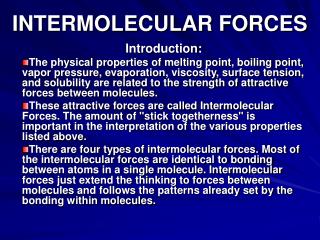
Vapor • Gas phase of substance that is normally liquid at room temperature • Some evaporation occurs at all temperatures • The easier a substance evaporates, the weaker the IMF
Fig a:open system Evaporation continues until all liquid is gone Fig b:closed system Rate of evaporation = rate of condensation System appears static due to equilibrium
molecules in liquid phase have range of KE; some have enough KE to“escape”from liquid phase
Vapor Pressure • Pressure exerted by vapor over its liquid • VP is affected by temperature: • higher the T, higher the VP
all liquids: VP ↑as T ↑
Vapor Pressure • VP does NOT depend on how much liquid is present • VP depends ONLY on temperature
STRONG FORCES Low VP Low rate evaporation High bp Large Hv IMF in Liquids WEAK FORCES • High VP • High rate evaporation • Low bp • Small Hv
Phase Changes • Melting • Boiling • Vaporization • occurs throughout liquid; T constant) • Evaporation (occurs only at surface; T ↓) • Sublimation • Freezing • Deposition • Condensation
Phase Changes are accompanied by energy changes • Endothermic Process: Energy is absorbed • Exothermic Process: Energy is released
freezing , condensation, deposition • Which phase changes absorb energy (endothermic)? • Which phase changes release energy (exothermic)? melting, boiling (vaporization), sublimation
Boiling Point • Temperature at which: VP liquid = external atmospheric P • Normal Boiling Point: temp at which VP liquid = 1 atm • Substances with high bp’s have strong IMF’s
Melting Point • = temp at which liquid & solid phases of substance coexist at equilibrium • higher the mp, the stronger the IMF
They’re the same: for H2O = 0˚C, 273K Freezing Point • Temp at which liquid is converted to crystalline solid • How does fp compare to mp?
Weak Strong Strong Weak Strong Weak Weak Strong Strong or Weak attractive forces? • High vapor pressure • Large Hv • High boiling point • Low boiling point • Low vapor pressure • Small Hv • Evaporates rapidly • Evaporates slowly
> < Boiling and Pressure • If increase external pressure (ex: camping in Death Valley), boiling point is ____ than 100oC • If decrease external pressure (ex: eating Raman noodles at top of Mt. Whitney), the boiling point is ____ than 100oC
EVAPORATION occurs at surface of liquid (or solid) occurs at all T liquid cools off as evaporates spontaneous all the time Boiling vs. Evaporation BOILING • occurs throughout liquid • occurs at definite T • occurs at constant T • only spontaneous when VP = external pressure