Download
1 / 20
200 likes | 307 Vues
This text explores the relationship between Earth, the Sun, and their movements in our solar system. It highlights the Sun as the center of our solar system, responsible for the energy and light reaching Earth. The Earth is depicted as an oblate planet with seasons influenced by its axial tilt and orbit around the Sun. Additionally, it discusses Earth's rotation and revolution, the concept of leap years, climate zones, and the Moon's orbit. By understanding these dynamics, one gains insight into how astronomical phenomena shape life on Earth.

E N D
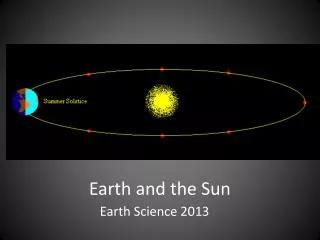
Earth and the Sun Earth Science 2013
Astronomy • Definition: The study of the ______, ______ and other objects in _____________
The Sun • The Sun is the center of our ______________ • There are ____ planets in our solar system • We are __________________from the Sun • The Sun is responsible for all the _______ we receive on Earth
Earth • The ___________ we live on • Only Planet with __________ (that we know of…) • _________ ________ from the Sun
Earth • The Earth is an _________ planet • _________________________ • _________________________ • _________________________
Earth’s Movements • ____________: One spin on its axis • Takes about ___________to rotate once • This rotation causes _______ and ________ • Sun always rises in the _____ and sets in the ________
Earth’s Movements • _____________ (orbit): One lap around the Sun • This takes about _________or one year to complete • The path is not quite a circle; its more of an _______________
Calendars • ______________ mark time on earth in 24 hour days and 365 days per year • The __________ astronomers counted the days between the appearance of the star Sirius and found an average of 365 days between appearances. • So the Egyptians came up with one of the first Calendars!
Leap Years • The path of the Earth around the Sun actually takes ____________to complete. • Every fourth year we add up the extra time ¼ + ¼ + ¼ + ¼ = _________________ • This day is added to the calendar every 4 years on __________________ • Leap Years: 2004, 2008, 2012, 2016, 2020, 2024, 2028, etc
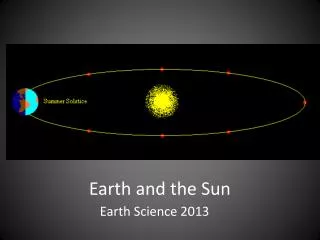
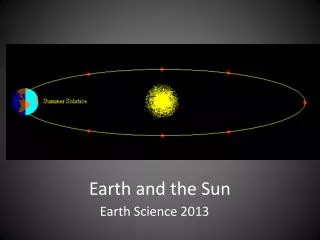
Earth’s Tilt • Earth has seasons because ______ _______ as it moves around the Sun • WE ARE IN THE __________ ____________ • When the Northern Hemisphere is tilted towards the Sun, we get the most sunlight = _____________ • When the Northern hemisphere is tilted away from the Sun, we get the least sunlight = _____________
Seasons • Most places on Earth have 4 distinct seasons: _____________________________________ • The length of each season depends on its location on the Earth and how the _________ hits the Earth • The __________________of the Earth creates three different climates: tropical, temperate, and polar
Season’s interactive • Click here
Four Seasons • Winter Solstice • Starts around _________________ • Northern Hemisphere is tilted _________ from the Sun • The rays from the Sun are the ___________ • _______________ day of the year in Northern Hemisphere; longest day of the year in the Southern Hemisphere • Marks the beginning of ___________
Four Seasons • Spring Equinox • Starts around _____________ • The Suns is directly over the _________ creating an equal amount of daytime and nighttime • Marks the beginning of ______________
Four Seasons • Summer Solstice • Starts around _______________ • Northern Hemisphere is tilted __________ the Sun • The rays from the Sun are the ____________ • ____________ day of the year in Northern Hemisphere; shortest day of the year in the Southern Hemisphere • Marks the beginning of the _____________
Four Seasons • Autumnal Equinox • Starts around _____________________ • The Suns is directly over the ____________ creating an equal amount of ___________ and ______________ • Marks the beginning of ______________
The Moon • The Moon takes ___________ to revolve around the Earth • The Moon takes 27.3 days to ___________on its axis • Therefore, we only ever see __________of the moon.