
SlideServe
Menu
Préférences
© SlideServe · v2026

Coordination Complexes - Summary

meghan-malone avatar
13 diapositives · 390 Views · Nov 17, 2014

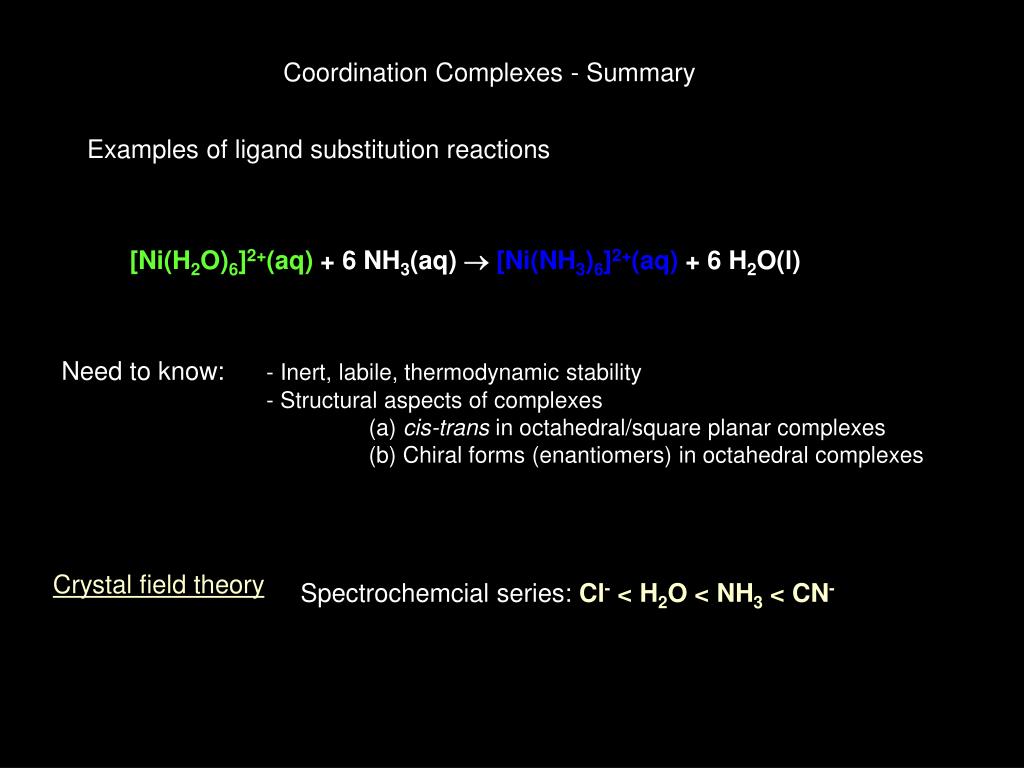
Coordination Complexes - Summary. Examples of ligand substitution reactions. [Ni(H 2 O) 6 ] 2+ (aq) + 6 NH 3 (aq)  [Ni(NH 3 ) 6 ] 2+ (aq) + 6 H 2 O(l). Need to know: - Inert, labile, thermodynamic stability - Structural aspects of complexes
Coordination Complexes - Summary - slide 1
01 / 13Coordination Complexes - Summary
1 / 17

Télécharger la présentation

Coordination Complexes - Summary
Une image / un lien ci-dessous est fourni (tel quel) pour télécharger la présentation

Politique de téléchargement : le contenu du site vous est fourni TEL QUEL pour votre information et votre usage personnel ; il ne peut être vendu, concédé sous licence ni partagé sur d’autres sites sans l’accord de son auteur.Le contenu vous est fourni TEL QUEL, pour votre information et votre usage personnel uniquement. Téléchargez la présentation en cliquant sur ce lien. Lors du téléchargement, si vous ne parvenez pas à télécharger une présentation, l’éditeur a peut-être supprimé le fichier de son serveur.Pendant le téléchargement, si vous ne parvenez pas à obtenir une présentation, le fichier a peut-être été supprimé par l’éditeur.

F I N

Plus de contenu associé

Transcription de la présentation
  1. Coordination Complexes - Summary Examples of ligand substitution reactions [Ni(H2O)6]2+(aq)+ 6 NH3(aq) [Ni(NH3)6]2+(aq)+ 6 H2O(l) Need to know: - Inert, labile, thermodynamic stability - Structural aspects of complexes (a) cis-trans in octahedral/square planar complexes (b) Chiral forms (enantiomers) in octahedral complexes Crystal field theory Spectrochemcial series: Cl- < H2O < NH3 < CN-

  2. z - - - - - - y x Mn+ Crystal Field Theory Which d-orbitals are effected the most?

  3. - - - - - - z z x x x M M dz2 along z-axis dx2- y2 along x-y axis These two d-orbitals constitute the higher energy eg set.

  4. - - - - dzx orbital has lobes between z-x axis z Less repulsion x M Likewise interactions for dxy and dyz These three d-orbitals constitute the lower energy t2g set.

  5. Octahedral Tetrahedral t2 eg Δt Δo e t2g Use diagram/spectrochemical series to explain: Absorption wavelengths due to electronic excitation Paramagnetic properties (unpaired electrons)

  6. L z y L L x Mn+ L L L Octahedral MO Diagram – s-bonded complex L Can be pz, s, or a hybrid Which d-orbitals form s-bonds with ligands at the corners of the octahedron?

  7. L Can be pz, s, or a hybrid L z z y x M L L M x dz2 along z-axis L dx2- y2 along x-y axis L Octahedral MO Diagram – s-bonded complex This results in the formation of 4 MO’s (eg and eg*).

  8. L z x M L L Octahedral MO Diagram – s-bonded complex dzx orbital has lobes between z-x axis NO OVERALP L Likewise interactions for dxy and dyz These three d-orbitals are non-bonding

  9. 4p 4s eg* L - AO’s 3d eg The Molecular Orbital Diagram t1u* a1g* Δo t2g t1u a1g

  10. Color in coordination complexes The colors are determined by Δ. Different ligands generate crystal fields of different strength. When the molecules absorb visible light, excited electrons jump from lower energy t2g to the higher energy eg orbital. The Δ (difference between energies of the two orbitals) is equal to the energy of the absorbed photon, and related inversely to the wavelength of the light. Weaker field ligands with smaller Δ emit light of longer λ and thus lower v. Similarly, stronger field ligands with larger Δ emit light of shorter λ and thus higher v. λ AbsorbedColor observed400nm Violet absorbed Green-yellow observed (λ 560nm)450nm Blue absorbed Yellow observed (λ 600nm)490nm Blue-green absorbed Red observed (λ 620nm)570nm Yellow-green absorbed Violet observed (λ 410nm)580nm Yellow absorbed Dark blue observed (λ 430nm)600nm Orange absorbed Blue observed (λ 450nm)650nm Red absorbed Green observed (λ 520nm)

  11. [Ti(CN)6]3- eg [Ti(H2O)6]3+ eg Do Do t2g t2g Problems 1. (a) When water ligands in [Ti(H2O)6]3+ are replaced by CN- ligands to give [Ti(CN)6]3-, the maximum absorption shifts from 500 nm to 450 nm. Is this shift in the expected direction? Explain. What color do you expect to observe for this ion? CN- is a stronger field ligand than H2O. Therefore the energy separation between the t2g and eg levels is greater. Ti3+ is a d1 metal ion. Do = hc/l. If D is larger, l is smaller. A(lmax) = 500 nm Solution appears red A(lmax) = 450 nm Solution appears yellow

  12. (b) The [Fe(H2O)6]3+ ion has a pale purple color, and the [Fe(CN)6]3- ion has a ruby red color. What are the approximate wavelengths of the maximum absorption for each ion? Is the shift of wavelength in the expected direction? Explain. CN- is a stronger field ligand than H2O. Therefore the energy separation between the t2g and eg levels is greater. Fe3+ is a d5 metal ion. Do = hc/l. If D is larger, l is smaller.