SlideServe
Menu
Préférences
© SlideServe · v2026

Ni & Cu Coordination Complexes

fallon avatar
8 diapositives · 408 Views · Aug 04, 2014

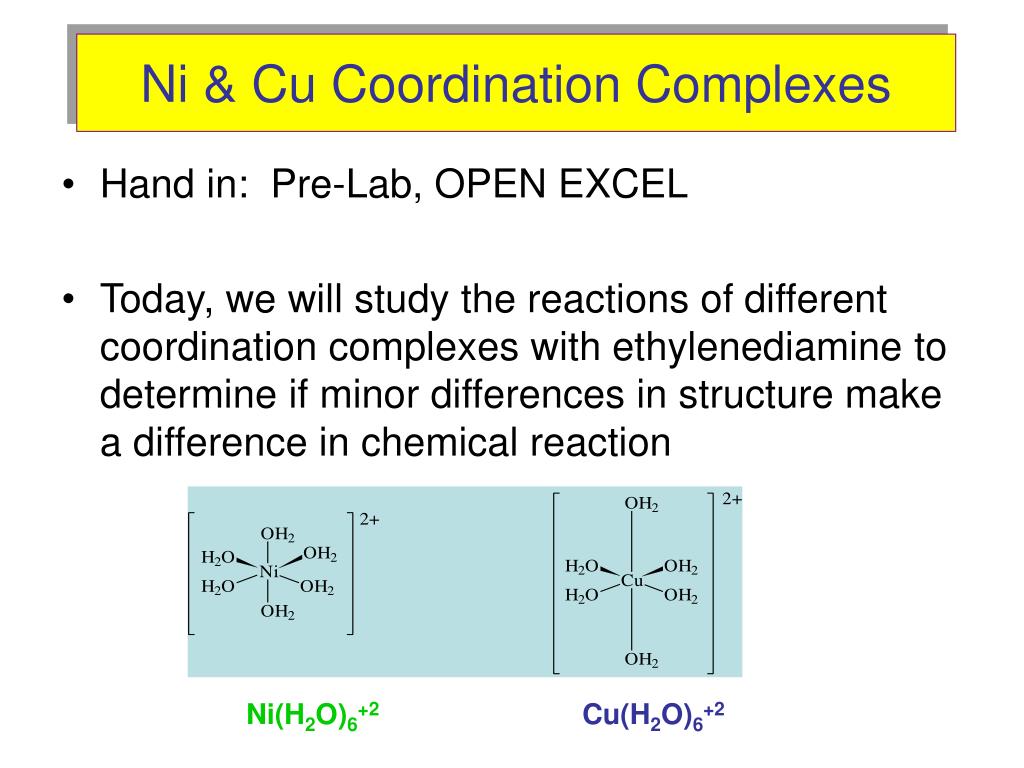
Ni & Cu Coordination Complexes. Hand in: Pre-Lab, OPEN EXCEL Today, we will study the reactions of different coordination complexes with ethylenediamine to determine if minor differences in structure make a difference in chemical reaction. Ni(H 2 O) 6 +2 Cu(H 2 O) 6 +2.
Ni & Cu Coordination Complexes - slide 1
01 / 8Ni & Cu Coordination Complexes
1 / 17

Télécharger la présentation

Ni & Cu Coordination Complexes
Une image / un lien ci-dessous est fourni (tel quel) pour télécharger la présentation

Politique de téléchargement : le contenu du site vous est fourni TEL QUEL pour votre information et votre usage personnel ; il ne peut être vendu, concédé sous licence ni partagé sur d’autres sites sans l’accord de son auteur.Le contenu vous est fourni TEL QUEL, pour votre information et votre usage personnel uniquement. Téléchargez la présentation en cliquant sur ce lien. Lors du téléchargement, si vous ne parvenez pas à télécharger une présentation, l’éditeur a peut-être supprimé le fichier de son serveur.Pendant le téléchargement, si vous ne parvenez pas à obtenir une présentation, le fichier a peut-être été supprimé par l’éditeur.

F I N

Plus de contenu associé

Transcription de la présentation
  1. Ni & Cu Coordination Complexes • Hand in: Pre-Lab, OPEN EXCEL • Today, we will study the reactions of different coordination complexes with ethylenediamine to determine if minor differences in structure make a difference in chemical reaction • Ni(H2O)6+2Cu(H2O)6+2

  2. Ni & Cu Coordination Complexes • Let’s consider the reaction between • ¨ ¨ • Ni(H2O)6+2 + H2N CH2CH2NH2 • Ni(H2O)6+2 + ethylenediamine (en) – first step Ni(en)3+2 coordination complex after three additions of en What will happen with Copper Complex’s slightly different geometry??

  3. Ni & Cu Coordination Complexes For the Experiment: 1. Set up Data Collection and Graph in EXCEL, a. on the x axis: Time (in secs) collect data every 10 secs b. on the y axis: Temp (oC) – note temperature change, when temperature is stable and not decreasing, add next volume of (en) c. Graph Live so you know when to add the next (en) 2. Prepare Equipment a. Coffee Cup Calorimeter b. Thermometer from Drawer 3. Obtain Reagents – WRITE DOWN CONC. ON BOTTLES ALL VOLUMES MUST BE EXACT!!!! a. Trial 1 - Nickel Complex – GREEN b. Ethylenediamine (en) – IN FUME HOOD WEAR GLOVES DISPENSE INTO A TEST TUBE AND COVER WITH PAPER ADD EN UNTIL NO CHANGE IS NOTED IN TEMP. (No more than 4 steps for either Trial) c. Trial 2 – Copper Complex – BLUE

  4. Ni & Cu Coordination Complexes 4. Actual Experiment a. obtain baseline temperature data for at least one to two minutes b. add (en) c. immediately cover and gently swirl d. collect data until temperature plateaus e. try not to let temperature drop f. add next (en) to the solution and repeat until temp no longer rises (no more than 4 (en) additions per trial). 5. SAVE YOUR DATA, RENAME!!!, and go to trial 2 with Cu +2 complex 6. ALL WASTE IN LARGE CONTAINER IN FUME HOOD

  5. Ni & Cu Coordination Complexes – Graphing in EXCEL (page 4 step 3)

  6. Ni & Cu Coordination Complexes – Calculations in EXCEL (Table on Page 5) Data Table to be generated in EXCEL by students:

  7. Ni & Cu Coordination Complexes What to do with the data? q rxn = - (3.8 J/g oC ) x masssol. x (Tf – Ti) Where: q rxn = energy released by the reaction mass sol. = TOTAL mass of liquid in the calorimeter Tf = Final Temperature in the STEP Ti = Initial Temp in the STEP So: mass sol. = density of liquid (g/mL) x mL of TOTAL soln. Then: Where: ΔH = Heat of reaction (kJoules/mole) mol (en) = moles of en in the STEP WATCH YOUR UNITS = Joules or Kilojoules!!!!

  8. Lab Report • Title Page • Purpose • Results - Two Graphs (page 5, #1) Ni(H20)6+2and ethylenediamine Cu(H20)6+2 and ethylenediamine - EXCEL Table, page 5, #2, (with sample calculations for Ni and Cu) - Present/Staple in order data/calculations were obtained/performed - Significant Figures and Units - Precision and Accuracy • Conclusion • AvgΔH for Ni reaction and AvgΔH for Cu reaction • Number of en’s per Ni complex (question #3, page 5) • Number of en’s per Cu complex (question #3, page 5) • Errors and Improvements • Individual Checked-Pre-labs