Exploring the Sun: Structure, Zones, and Stellar Phenomena
Discover the fascinating structure of the Sun with a diameter of 1.35 million kilometers and a mass 330,000 times that of Earth. Learn about the Sun's key zones, including the cooler sunspots that signal storms, the radiant photosphere, the middle-layer chromosphere, and the extreme temperatures of the corona. Dive into the phenomenon of solar prominence and uncover the nuclear fusion processes happening at the Sun's inner core. This guide provides insights into the Sun's composition, behavior, and vital role in our solar system.

Exploring the Sun: Structure, Zones, and Stellar Phenomena
E N D
Presentation Transcript
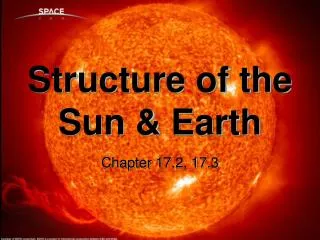
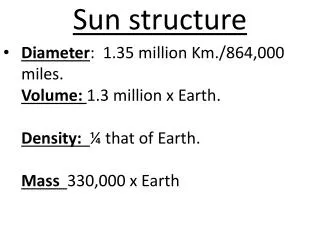
Sun structure Diameter: 1.35 million Km./864,000 miles.Volume: 1.3 million x Earth.Density: ¼ that of Earth.Mass 330,000 x Earth
ZONES OF THE SUN • SUN SPOTS:STORM IN THE LOWER ATMOSPHERE OF THE SUN THAT APPEAR AS DARK SPOTS ON THE SURFACE. THEY APPEAR DARK BECAUSE THEY ARE COOLER THAN THE REST OF THE SUNS SURFACE. MOVEMENT OF SUNSPOTS INDICATES THAT THE GASES IN THE SUN SPIN, OR ROTATE.
PHOTOSPHERE • 6,000 C THE INNERMOST LAYER OF THE LIGHT PRODUCING PART OF THE SUN. OFTEN REFERRED TO AS THE ‘SURFACE’ OF THE SUN BECAUSE WE CAN SEE IT.ABOUT 550Km THICK (488 MILES).
CHROMOSPHERE • 27,800 CBENEATH THE CORONA IN THE MIDDLE LAYEROF THE SUNS ATMOSPHERE. • SEVERAL THOUSAND Km THICK (2938 MILES).
CORONA • THE OUTERMOST LAYER OF THE SUN’S ATMOSPHERE. TEMPERATURES CAN REACH 1,700,000 C.
SOLAR PROMINENCE • TWISTED LOOPS OF HOT GAS THAT USUALLY ORIGINATE IN THE CHROMOSPERE. THIS IS A VIOLENT STORM ON THE SUN.
INNER CORE • 15,000.000 CTHIS IS WHERE HYDROGEN ATOMS ARE FUSED INTO HELIUM ATOMS IN THE NUCLEAR FUSION REACTION.THE PROCESS IS CALLED NUCLEOSYNTHESIS.